
Archaeological site guide
Kodumanal
Examine a Noyyal-river site where settlement, craft production, inscriptions, burials, and inland exchange meet without turning one discovery into a claim about an entire civilization.
Orientation
Overview
Megalithic/Iron Age and early historic phases; dates depend on excavated context
Kodumanal lies on the northern bank of the Noyyal River in present-day Erode district. Tamil Nadu Archaeology identifies both megalithic and early historic cultural phases and records excavations in several seasons. The site is important because habitation, craft production, writing, exchange, and burial evidence can be studied within one wider archaeological landscape.[1][2][3]
Excavated materials include Black-and-Red Ware and other ceramics, beads and bead-making evidence, iron objects and industrial remains, inscribed and graffiti-marked potsherds, structures, animal bones, and megalithic burials with grave goods. These categories do not all belong to one moment. Stratigraphy, object association, scientific analysis, and publication are needed to connect them.[1][3][4]
Kodumanal is often linked with Kodumanam in early Tamil literature and with routes between the Chera centre at Karur and the western coast. That interpretation is historically productive, but a literary place-name, excavated settlement, and reconstructed trade route are different kinds of evidence. The strength of the case comes from comparison, not from treating one source as proof of every other.[3][6]
Chronology
A careful timeline
Dates identify documented phases and broad ranges. They do not imply uninterrupted rule or certainty where the evidence remains debated.
Burial and material traditions
Cairn circles, cists, urns, ceramics, iron objects, and ornaments occur in recorded mortuary contexts whose dates require site publications.[1]
Settlement and production
Habitation deposits, furnaces, craft debris, ceramics, and writing provide evidence for specialized activity and exchange.[3]
State archaeology excavations
Tamil Nadu Archaeology's register records excavation seasons that helped establish the site's settlement and burial significance.[2]
Renewed investigation
Further trenches examined industrial activity, structures, inscriptions, and the transition between cultural phases.[2][3]
Publication and reanalysis
Official reports and specialist analysis remain essential for refining chronology, production, mobility, and exchange.[4]
Historical reading
A western Tamil Nadu route landscape
The Noyyal valley links the Kaveri basin with routes through the Palghat Gap toward the west coast. Kodumanal's position makes exchange a reasonable research question, but location alone does not prove the volume, direction, or political control of trade. Archaeologists compare raw materials, manufacturing waste, finished objects, ceramics, coins, and regional sites.
Present administrative geography matters for stewardship: Kodumanal is in Erode district. Historical connections crossed today's border and district lines. The site can be linked to Karur, western passes, and coastal exchange without drawing an unsupported fixed corridor for every period.[3][7]
Historical reading
Settlement, structures and industrial activity
Official excavation summaries describe floor levels, stone-built features, furnaces, burnt clay, pottery, animal bone, and other habitation evidence. Furnace remains and production debris support interpretation of industrial activity more directly than a finished object found without manufacturing context.[3]
Iron-working involved ore procurement, fuel, furnaces, slag, tools, technical knowledge, and labour. Bead production similarly required raw material, shaping, drilling, polishing, and distribution. Different workshop areas and phases may overlap or move. The phrase industrial centre is useful only when tied to this material sequence rather than imagined as a modern factory town.
Historical reading
Beads, raw materials and skilled production
Quartz, carnelian, clay, and other bead materials appear in the Kodumanal record. Unfinished pieces, tools, waste, and concentrations can reveal stages of manufacture. A large group of carnelian beads in a burial is evidence about mortuary selection as well as craft and exchange; it does not by itself identify the occupation or ethnicity of the buried person.[1]
Compositional and technological studies can help trace raw materials and workshop choices. Distribution must be demonstrated by securely provenanced finds at other sites. Similar-looking beads can travel, be copied, reused, or deposited long after manufacture, so typology and context must work together.
Historical reading
Inscribed sherds and graffiti marks
Tamil-Brahmi inscribed potsherds are direct evidence for writing on portable objects in early historic contexts. A short personal name or mark can reveal literacy practice and object use, but it is not a narrative text. Reading depends on the preserved letters, direction, language, and archaeological layer.[5][3]
Graffiti marks require separate treatment. Repeated signs may be meaningful, but not every mark is writing and no isolated sign safely establishes language, ethnicity, or political identity. Published drawings, photographs, and context are more reliable than enhanced images circulating without a catalogue number.
Historical reading
Cairn circles, cists and grave goods
Tamil Nadu Archaeology reports excavation of a megalithic cairn circle with a primary cist, associated vessels, an urn, beads, iron weapons, and other objects. Their placement is part of the evidence. Removing a visually impressive object from its plan, depth, and association would destroy the mortuary sequence.[1]
Burials can inform studies of ritual, status, technology, health, diet, and mobility, but grave goods are not a direct biography. A weapon does not automatically prove a warrior identity; many beads do not define a merchant; burial form does not map directly onto a named dynasty. Human remains and funerary contexts require legal and ethical care.
Historical reading
Trade, literature and the limits of identification
The literary name Kodumanam has been connected with the excavated place, and the site is frequently discussed within routes joining Karur and the western coast. This convergence of text, geography, craft, and material exchange is significant. Yet literary composition and transmission have their own chronology, while the archaeological site contains multiple phases.[3][6]
A strong account states the chain of reasoning: where an object was found, whether it was made locally, how its material was sourced, what comparative sites show, and how a text is dated. Phrases such as proves ancient global trade conceal those steps. Kodumanal matters because it permits the steps to be studied.
Historical reading
Responsible exploration and continuing research
An archaeological site is not an open collection ground. Visitors should remain outside trenches and protected areas, never remove sherds or slag, avoid touching inscriptions, and report concerning finds to the archaeology authority. Exact locations of vulnerable material should not be amplified online.
Access, active excavation, conservation work, and displays can change. This guide therefore links the Erode district and archaeology authorities but does not promise opening hours, on-site interpretation, or current facilities. The excavation report remains more informative than a brief visit for understanding context.[4][2]
Study desk
Research notes for careful readers
Use these questions to move from an overview of Kodumanal to evidence-led historical study.
Build chronology from anchors
Begin with evidence that carries its own recoverable context: a dated inscription, an excavated layer, a documented coin hoard, a building phase, a letter, or an administrative file. Then place less certain material around those anchors. A royal genealogy, literary allusion, stylistic comparison, or later tradition may be highly informative without supporting an exact year. Writing the evidence type beside every date prevents a reconstructed sequence from looking more certain than its foundations.[1]
Watch for gaps and overlaps. Dynastic names can disappear from one kind of record and return in another; two rulers may claim authority at the same time; a monument can be begun, enlarged, repaired, and reinterpreted under different patrons. Period labels are tools for organizing change, not walls between communities. A timeline should therefore identify phases and transitions instead of pretending that one court handed a complete territory to the next on a single day.[2]
Read maps as arguments
Historical maps are reconstructions. An inscription naming a victory, a poem praising a ruler, a coin found in circulation, and a grant made in a village describe different relationships to place. None by itself proves a permanently administered frontier. Useful maps distinguish core areas, attested sites, campaign claims, routes, tributary relationships, and uncertain zones. They also use the coastline, river course, and place names appropriate to the period being discussed.[3]
Modern Tamil Nadu remains the geographic focus of this site, but historical networks crossed its present boundary. Ports connected to Sri Lanka and the wider Indian Ocean; inland routes crossed the Ghats; religious and merchant institutions operated across several political regions; the Madras Presidency extended far beyond today's state. A regional history becomes clearer when present-day borders orient the reader without containing the past.
Account for survival and silence
Stone temples, copper plates, official files, and elite literary collections survive for particular reasons. Durable material and institutional custody make some voices much louder than others. Workers may appear only through wages or duties, women through gifts or prosecutions, rural communities through tax demands, and defeated groups through an opponent's praise. Silence can indicate loss, exclusion, or the source's purpose; it cannot safely be converted into proof that a person or practice was absent.[4]
Translation adds another layer. Titles, offices, social terms, ritual vocabulary, and place names do not always have one modern equivalent. A smooth English phrase can hide alternatives in the original language. Where an interpretation depends on one word, consult the transcription, translation notes, and more than one scholarly reading. Quotations should come from a checked edition rather than from unsourced graphics or repeated web summaries.
Compare at the right scale
Comparison is strongest when the units truly match. A burial site should not be measured against a capital city as though they served the same function. One king's regnal inscription should not be compared directly with a literary anthology compiled over time. Instead compare burial with burial, workshop with workshop, grant formula with grant formula, and securely dated architectural phase with another documented phase. Regional synthesis comes after those controlled comparisons.
Public history adds valuable questions but can also reward superlatives. Claims about the oldest, greatest, first, largest, or most advanced require a clearly defined comparison set and published evidence. Historical significance does not depend on winning such a ranking. A site or tradition can matter because it changes an interpretation, preserves an unusual archive, or connects people and landscapes in a way that no simple contest can express.
Preserve the evidence you came to see
Historical study continues at living temples, museums, archives, archaeological sites, streets, water systems, and working landscapes. Follow access rules, never touch or enhance inscriptions, do not remove surface finds, ask before photographing people or rituals, and treat conservation closures as part of responsible care. Record the institution, gallery, accession number, monument, or report behind an observation so that it can be checked later.
The best next question is often narrower than the first: which phase of this building, which version of this text, which sample from which layer, which office produced this file, or which community preserved this memory? Narrow questions are not a retreat from big history. They are how large claims become reliable enough to connect.
Human scale
People and institutions
Named rulers are only one part of the history. These groups and individuals help show how evidence and social life connect.
Field archaeologists
Record layers, structures, burials, objects, and samples through an irreversible excavation process.
Epigraphists
Document and interpret short inscriptions without detaching script from context.
Craft specialists
Study bead manufacture, metallurgy, ceramics, and production debris.
Bioarchaeologists and conservators
Handle human remains and fragile materials through legal, ethical, and scientific protocols.
Local communities
Residents and land users whose landscape knowledge, rights, and stewardship are part of responsible archaeology.
Historical geography
Connected places
Places are linked only when a substantive My Tamil Nadu guide already exists. Other entries remain non-clickable research context.
Visual reading
Images with explicit provenance
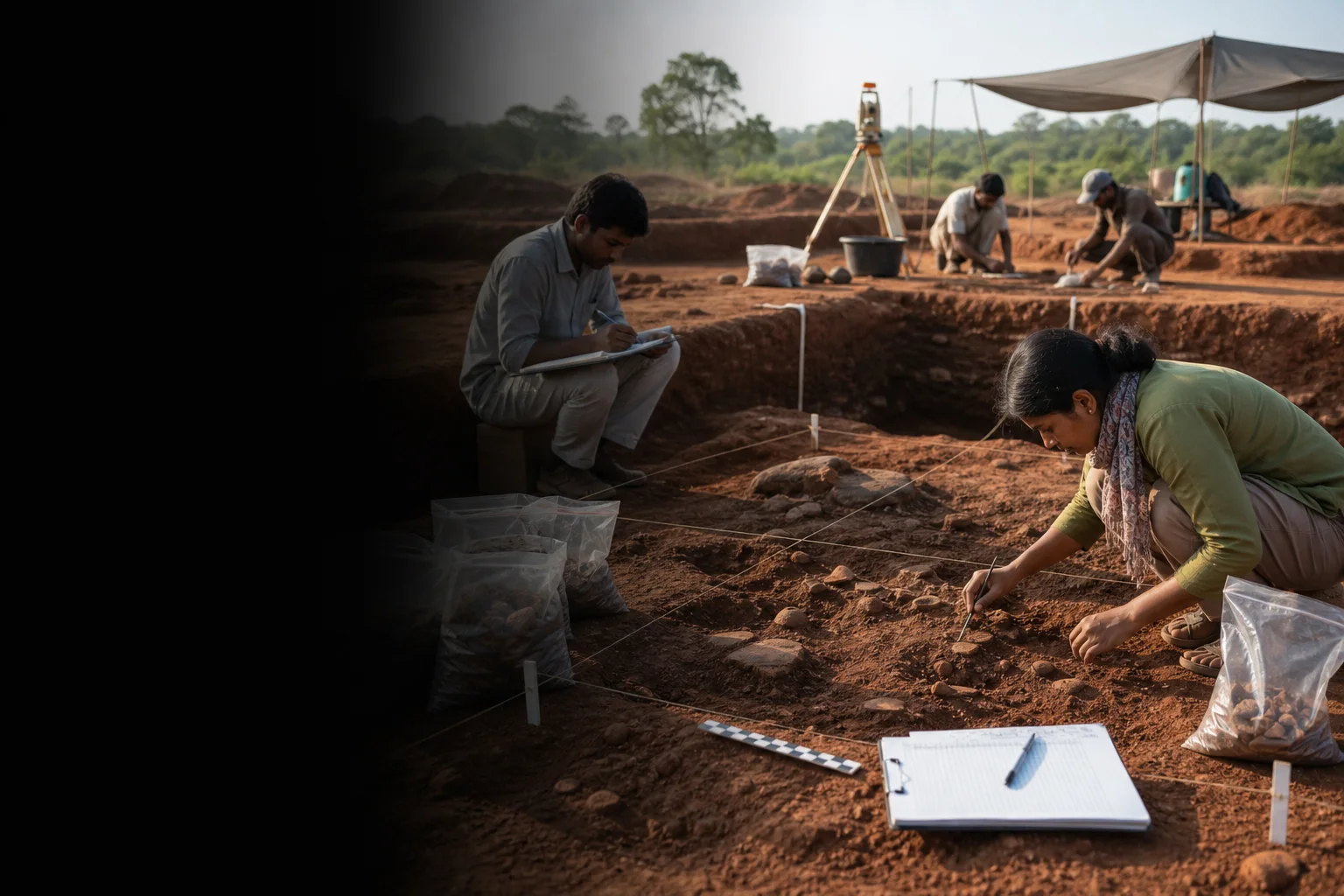
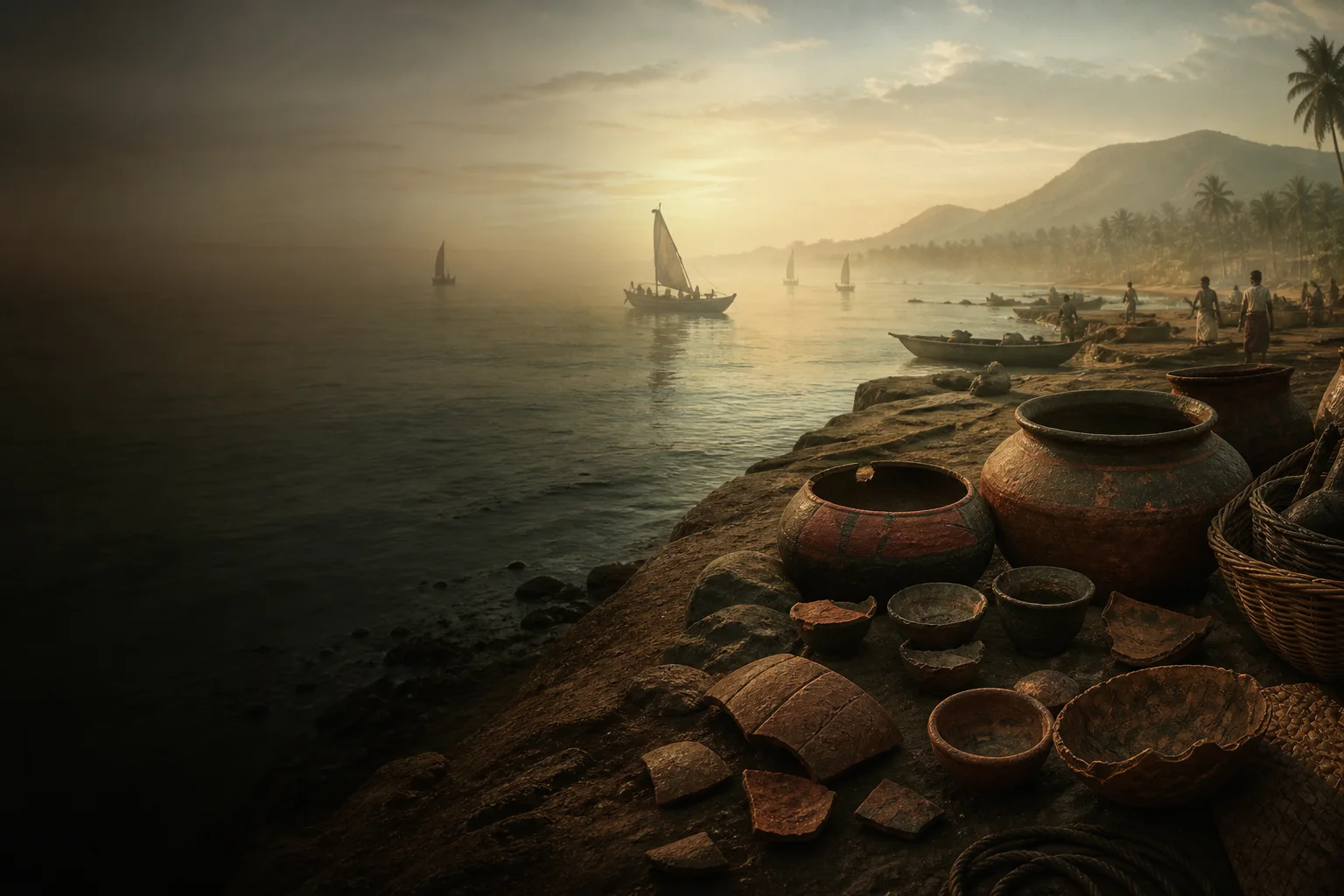
These project-created visuals support orientation. They are not presented as photographs of an excavation, monument, person, or event.
Questions
Frequently asked questions
Why are some dates given as ranges?
Historical periods overlap, and inscriptions, chronicles, archaeological contexts, and later reconstructions do not always support one exact year.
Does a royal inscription provide a neutral account?
No. It is primary evidence made for a purpose. Historians compare its language and setting with other inscriptions, material evidence, texts, and later records.
Can monuments be assigned to only one ruler or period?
Often not. Major complexes were built, enlarged, repaired, and reinterpreted by several patrons and communities.
Are current opening hours or access conditions included?
No. Access, conservation closures, fees, and photography rules can change. Check the responsible authority before visiting.
Can historical interpretation change?
Yes. New publications, excavation results, inscriptions, archival work, and scholarly debate can revise established accounts.
How were sources chosen?
Priority was given to government archaeology and archives, India Code, national cultural institutions, and university history resources.
Editorial trust
Sources and further reading
Citations in the article point to this full list. Source type and review date are shown so readers can evaluate the evidence.
- 1Kodumanal excavationTamil Nadu State Department of ArchaeologyOfficial site report · Reviewed 21 August 2026
- 2Archaeological excavations in Tamil NaduTamil Nadu State Department of ArchaeologyOfficial excavation register · Reviewed 21 August 2026
- 3Ongoing Archaeological Excavations in Tamil Nadu: Kodumanal status reportTamil Nadu State Department of ArchaeologyOfficial excavation status report · Reviewed 21 August 2026
- 4Department e-publications: Kodumanal excavation reportTamil Nadu State Department of ArchaeologyOfficial publication catalogue · Reviewed 21 August 2026
- 5Tamil-Brahmi scriptTamil Nadu State Department of ArchaeologyOfficial epigraphy overview · Reviewed 21 August 2026
- 6Polity in the Sangam AgeUGC e-PG Pathshala / INFLIBNETUniversity teaching module · Reviewed 21 August 2026
- 7Chera Site Museum, KarurTamil Nadu State Department of ArchaeologyOfficial site-museum guide · Reviewed 21 August 2026
- 8Department e-publicationsTamil Nadu State Department of ArchaeologyOfficial publication catalogue · Reviewed 21 August 2026
Editorial review: Factual claims were checked against the linked primary and institutional sources on 21 August 2026. Where the sources support only a range or interpretation, the article keeps that limitation visible.

A Journey Through Chola Heritage in Tamil Nadu
Follow a thoughtful route through three living Chola temple landscapes, learning to read architecture, inscriptions, patronage, and place without rushing.
Sittannavasal: Read a Jain Hill Through Paint and Stone
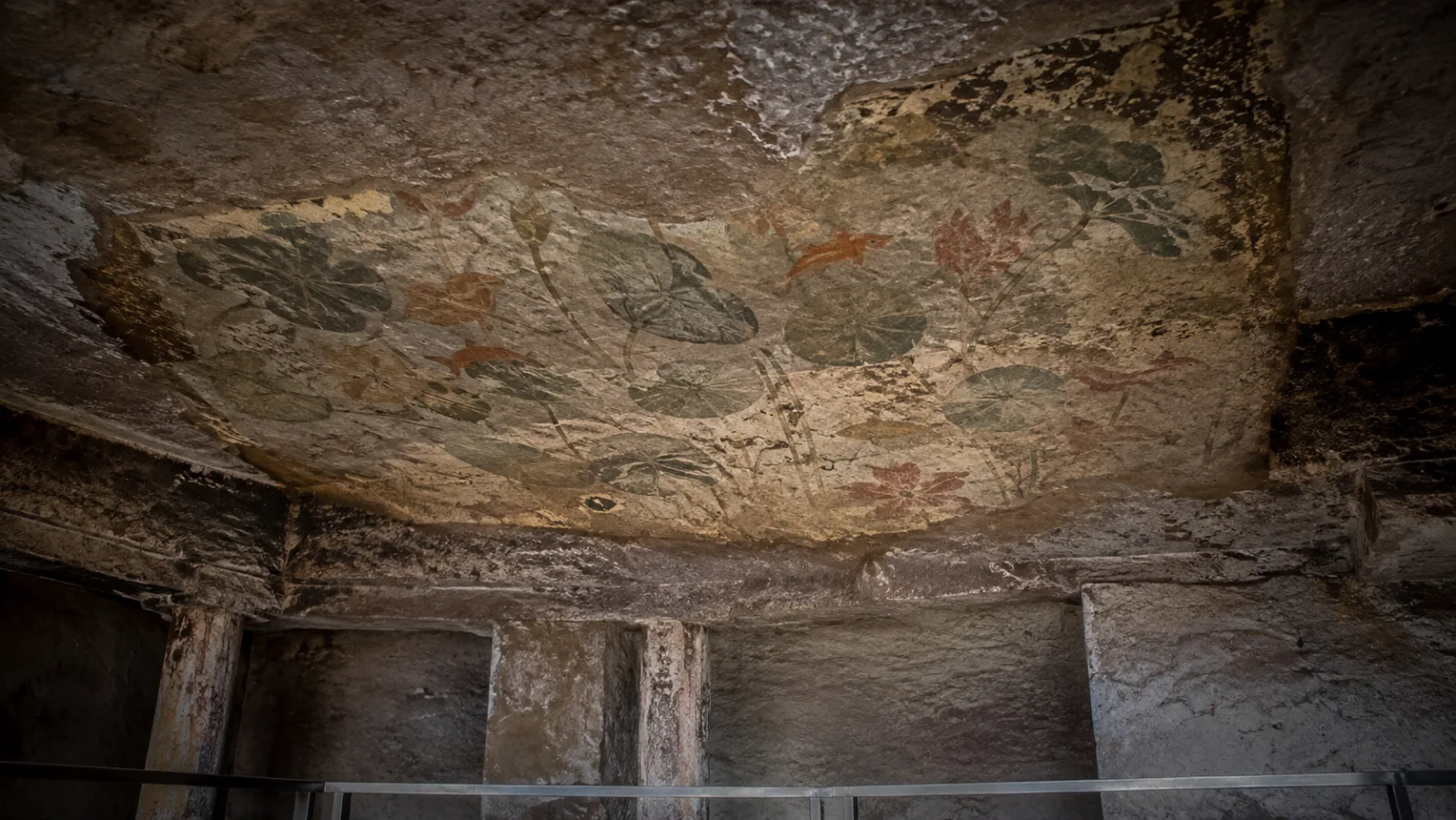
A conservation-first guide connecting Sittannavasal's Jain cave, fragmentary paintings, rock beds and inscriptions without forcing them into one date.

Chennai Government Museum: Read a Campus of Collections
A first-visit method for reading the Egmore museum as an evolving campus of architecture, archaeology, bronzes, inscriptions and public education.