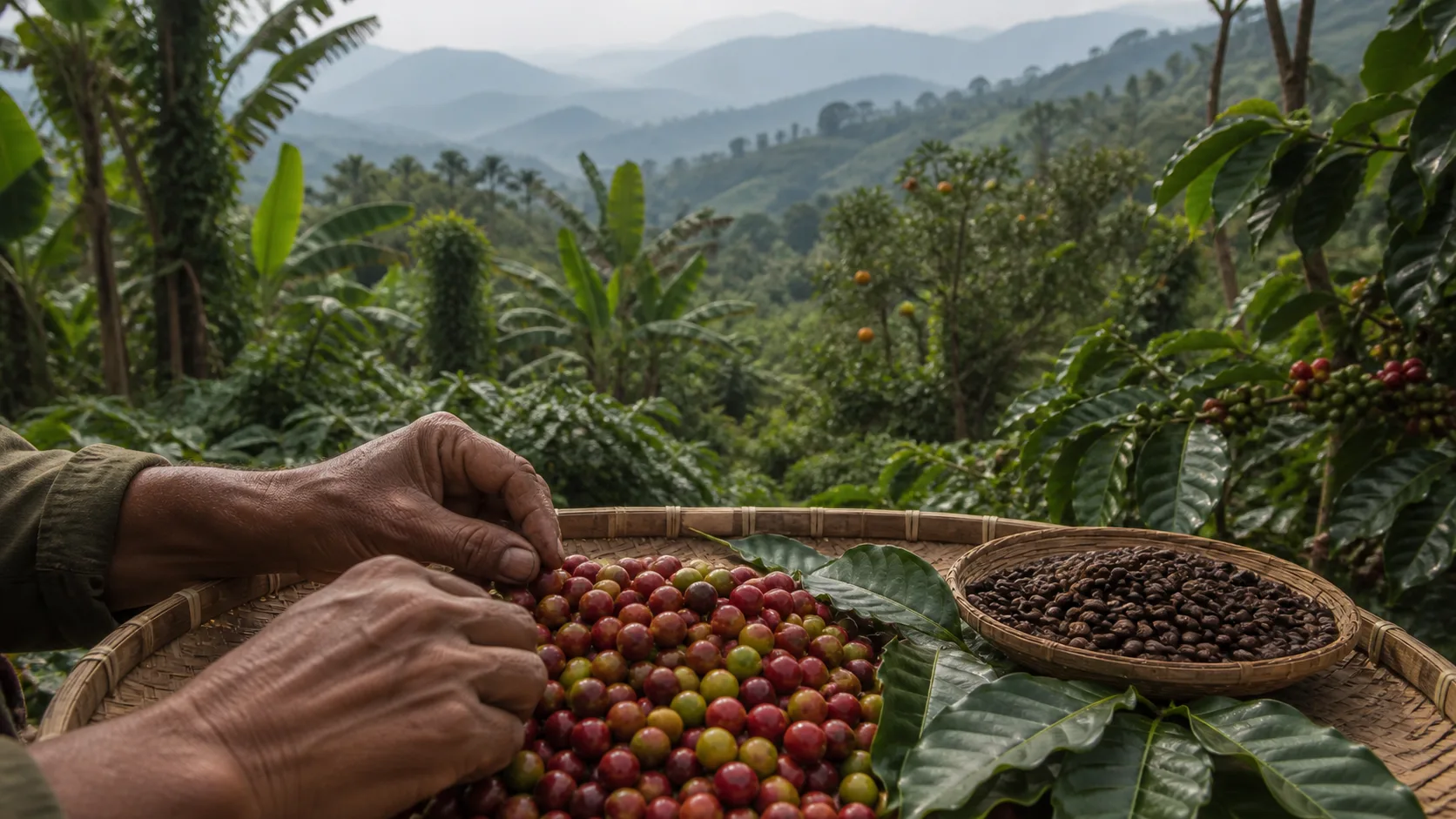
Begin with four recognised producing regions
Coffee Board of India identifies the Nilgiris, Pulneys, Shevaroys and Anamalais among Tamil Nadu's coffee regions. These names refer to mountain systems and producing zones, not four protected flavour guarantees. Farms within one region still vary by elevation, slope, shade, soil, variety and management.
Coffee Board statistics record both Arabica and Robusta in Tamil Nadu, with the balance differing by region. Pulneys and Shevaroys are strongly associated with Arabica in the Board's regional profiles, while the Nilgiris and Anamalais include both. A packet that says Tamil Nadu coffee therefore remains incomplete origin information.
Use a map to connect region with district: the Nilgiris, Palani Hills around Dindigul, Shevaroy Hills around Salem and Anamalais near Coimbatore and Tiruppur landscapes. Administrative and ecological boundaries do not always match marketing shorthand exactly.
Sources for this section: Coffee regions of India, Coffee statistics.
Coffee often grows inside a mixed farm system
Coffee Board profiles list intercrops such as pepper, orange, banana, cardamom, ginger and vegetables in Tamil Nadu regions. These crops can share shade, labour, land and household income, but the exact mix belongs to each farm. One picturesque estate should not be presented as the standard landscape.
Shade is not a single certification. Ask which trees are present, whether coffee is Arabica or Robusta and how the farm handles soil and water. A wildlife claim on packaging also needs evidence; proximity to a forest does not make the coffee automatically biodiversity-friendly.
Visit only farms that publicly receive guests or have invited you. Follow hygiene and worker-safety instructions, ask before photographing labour and never taste cherries, enter processing areas or operate equipment without permission.
Sources for this section: Coffee regions of India, Tamil Nadu coffee research.
The bean is a seed shaped by processing
Coffee begins as fruit. Picking maturity, separating cherries, removing pulp, fermentation, washing or dry processing, drying, storage and roasting all influence the final cup. Origin matters, but it does not act alone. A dark roast can reduce differences that might be clearer at another roast level.
Washed and natural are processing descriptions, not automatic quality ranks. Ask what the producer or roaster means, when the coffee was roasted and how it should be brewed. Avoid repeating tasting notes as objective ingredients; citrus, chocolate or spice language describes sensory associations, not added material unless the label says flavouring was used.
Current crop year, lot availability and price change. This guide does not name a best harvest or seller. Use packet information, a transparent roaster and direct producer documentation rather than an undated listicle.
Sources for this section: Coffee regions of India, Coffee statistics.
Read a packet as a set of claims
Look for producer or cooperative, region, species, variety where known, processing method, roast date and net quantity. A hill-station name can be a useful origin clue, but it may also be a brand address. Ask whether the coffee was grown there, processed there, roasted there or only sold there.
Single origin usually means a defined source selected by the seller; it is not one universal legal standard that answers every traceability question. Estate, organic, shade-grown and specialty also need supporting information. Do not infer certification from green packaging or a mountain illustration.
Coffee Board directories and regional material can verify institutional and geographic context, not authenticate every retail packet. Keep the invoice for an expensive purchase and contact the seller when the label omits a claim central to the price.
Sources for this section: Coffee Board directory, Coffee statistics.
Separate origin coffee from degree-coffee culture
Kumbakonam degree coffee is a preparation and service tradition associated with strong decoction and milk; it is not a coffee-growing region. A café can use beans from one or several origins, and a Tamil Nadu-grown coffee can be brewed by filter, immersion, espresso or other methods.
Keeping origin and preparation separate improves both stories. Ask where the coffee grew, then ask how it was roasted and brewed. Chicory, milk, sugar and vessel affect the served drink but do not change the agricultural origin of the coffee component.
Taste comparatively rather than declaring one region best. Try the same brew method across origins or the same origin across roast levels, record what you notice and accept variation. The goal is a more precise relationship with farmers, processors and place, not a new hierarchy of prestige.
Sources for this section: Coffee regions of India, Tamil Nadu coffee research.
Build an origin journey without turning farms into displays
Choose one producing landscape and connect it with an existing district or destination guide. A Nilgiris journey, a Palani Hills stay, a Shevaroy Hills route or an Anamalai visit can provide geographic context, but none guarantees access to a working estate. Arrange farm visits only through a public programme or direct invitation.
Ask concise questions about region, species, processing and roast date, and purchase only when the answers are clear enough for your purpose. Respect a producer who cannot host visitors during work, weather or harvest pressures. Agricultural hospitality is a service, not an automatic right attached to buying a packet.
Current harvest timing, stock, prices, tours and transport require direct verification. The durable part of the journey is learning to distinguish a mountain region, a farm claim, a processing method and a preparation tradition, then crediting each accurately when sharing the experience.
Sources for this section: Coffee Board directory, Coffee database.
Sources & Further Reading
These authoritative references support the historical, geographic, or seasonal context in this story. Current conditions and operating details still require a fresh official check.
- Coffee Regions - India · Coffee Board of India
- Coffee Statistics · Coffee Board of India
- Coffee Research · Coffee Board of India
- Directory · Coffee Board of India
- Database on Coffee · Coffee Board of India
Related Stories
Kodaikanal Beyond the Lake: Shola, Grassland and Solar Science
A hill-station guide that connects Kodaikanal's familiar town landscape with Palani Hills ecology and more than a century of solar observation.
A Food Journey Through Tamil Nadu's Regional Cuisines
Travel across Tamil Nadu through the relationships among region, crop, technique, household memory, migration, worship, and changing city life.
Tamil Nadu Tiffin Culture: Idli, Dosa, Pongal and the Morning Table
Read Tamil Nadu's morning table through fermented batter, quick service, home preparation, public eating and the many meanings of tiffin.
Frequently asked questions
Which are Tamil Nadu's main Coffee Board regions?
The Board profiles the Nilgiris, Pulneys, Shevaroys and Anamalais.
Is Kumbakonam a coffee-growing origin?
Kumbakonam degree coffee is principally a preparation and service tradition, not one of the four Coffee Board growing regions discussed here.
Does single origin guarantee quality?
No. It describes sourcing as defined by the seller; farming, processing, storage and roasting still matter.
Editorial attribution
Prepared and reviewed by My Tamil Nadu Editorial Desk. Modified 31 August 2026.