Read Tenkasi and Courtallam as one regional landscape
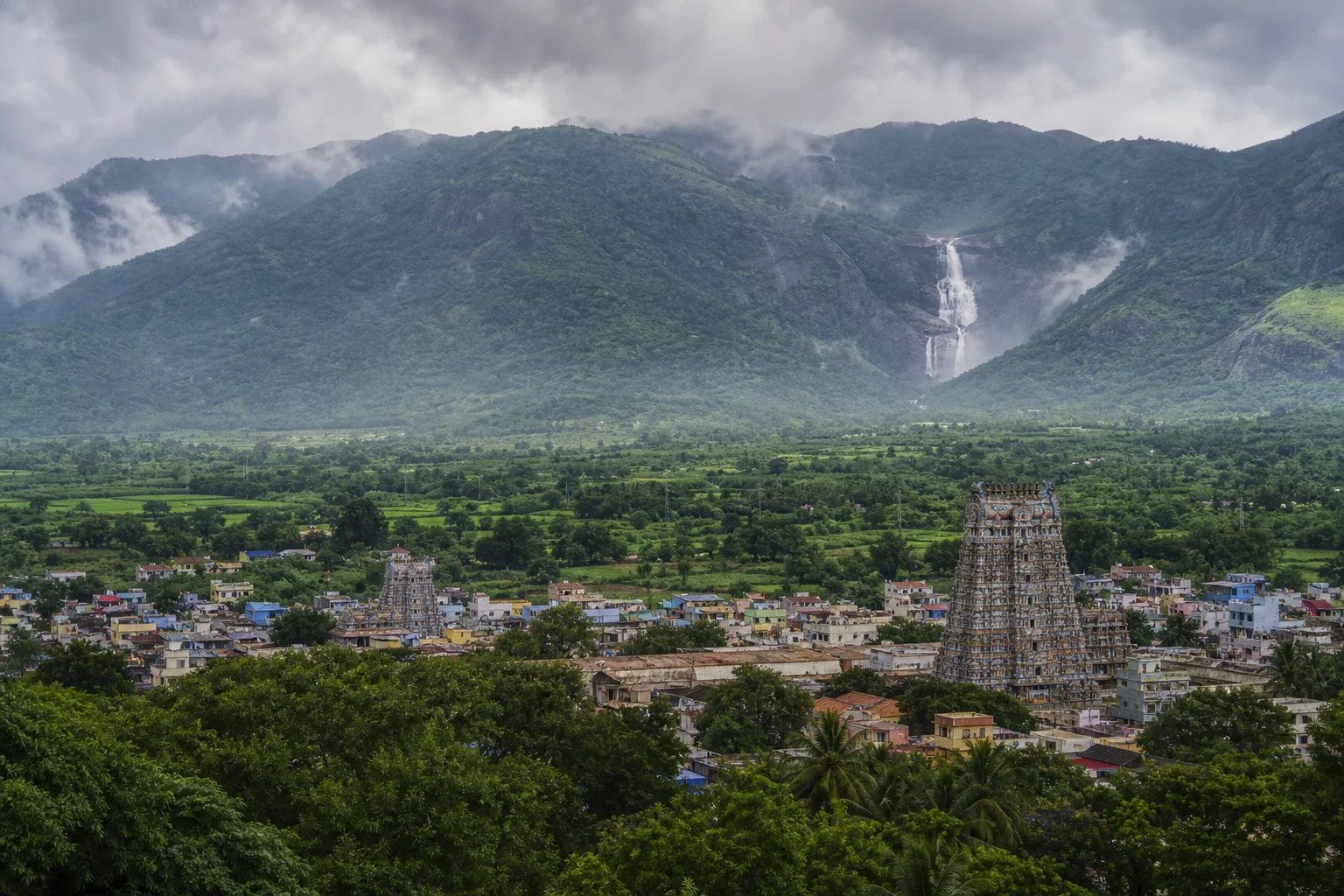
Tenkasi town and Courtallam are close enough to be combined casually, yet they are often described through separate labels: temple town on one side, waterfall resort on the other. A more useful reading begins with the Western Ghats rising immediately to the west, short river systems descending toward the plains, and settlements positioned where mountain water, agriculture, roads and sacred places meet. The district administration identifies Courtallam at the Western Ghats and presents its falls as a major attraction, while Tenkasi remains the district's urban and transport centre.
This relationship explains why a journey can change character over a short distance. A visitor may move from a dense temple street to cultivated foothills, mist, rocky channels and regulated waterfall spaces without leaving the same regional system. The landscape is compact, but it is not simple. Water flow, forest boundaries, road access and crowd conditions are variable, and the sacred meaning of each place cannot be reduced to scenery.
Sources for this section: Tenkasi tourism, Courtallam.
Tenkasi's centre is a sacred urban place
Tenkasi's name and identity are closely associated with Kasi Viswanathar Temple. The HR&CE record places the temple in the centre of the town and associates it with later Pandya patronage. The permanent value of that source is institutional identification; any opening hours or festival arrangements shown there remain changeable and must be checked at the time of travel. The temple's position helps explain why Tenkasi should not be treated only as a rail or road gateway to Courtallam.
Around a major town temple, worship, commerce and transport occupy the same public realm. Visitors should allow space for ordinary local movement and avoid treating a gopuram view as permission to photograph every ritual or person nearby. Architectural interpretation also benefits from restraint: one patron, inscription or reconstruction phase should not be used to date an entire living complex. Tenkasi's sacred centre is a starting point for reading the region, not a decorative pause before the waterfalls.
Sources for this section: Kasi Viswanathar Temple, Tenkasi District.
At Courtallam, sacred place and falling water overlap
Courtallam is not only a cluster of bathing waterfalls. The district administration identifies Kutraalanatha Swamy Temple among its important places, and the temple's proximity to the Main Falls makes sacred and hydrological landscapes visibly adjacent. Literature, local tradition and worship give the waters meanings that a recreational account cannot capture. At the same time, devotional importance does not make every channel publicly accessible or every natural condition safe.
The relationship is best understood without making medicinal promises. Official tourism descriptions repeat the familiar claim that water passing through forest and herbs has special value, but a general editorial article should not convert that cultural reputation into a health guarantee. Visitors can acknowledge the long-standing association between water, place and well-being while relying on medical guidance for health questions and official notices for bathing access.
Sources for this section: Courtallam temple, Courtallam.
Waterfall flow is a seasonal condition, not a permanent feature
Courtallam's named falls belong to short mountain-fed watercourses associated with the Chittar system. Rain over the Ghats, catchment response and local management influence what visitors encounter. A photograph of strong flow cannot predict conditions next week, and a calendar range cannot guarantee safe bathing. Even official tourism pages may retain broad seasonal phrases after on-ground conditions have changed. Current access belongs to district, police, forest and local authority notices.
This is especially important because different falls have different settings and controls. Some are close to developed public areas; others approach forest or restricted landscapes. Historical popularity is not evidence of present permission. Never follow informal paths, cross barriers or assume that visible water is safe. The useful evergreen knowledge is geographic: mountain rainfall becomes rapid surface flow, and that dynamism is exactly why beauty and hazard can increase together.
Sources for this section: Tenkasi famous falls, Courtallam.
The Western Ghats are the regional framework
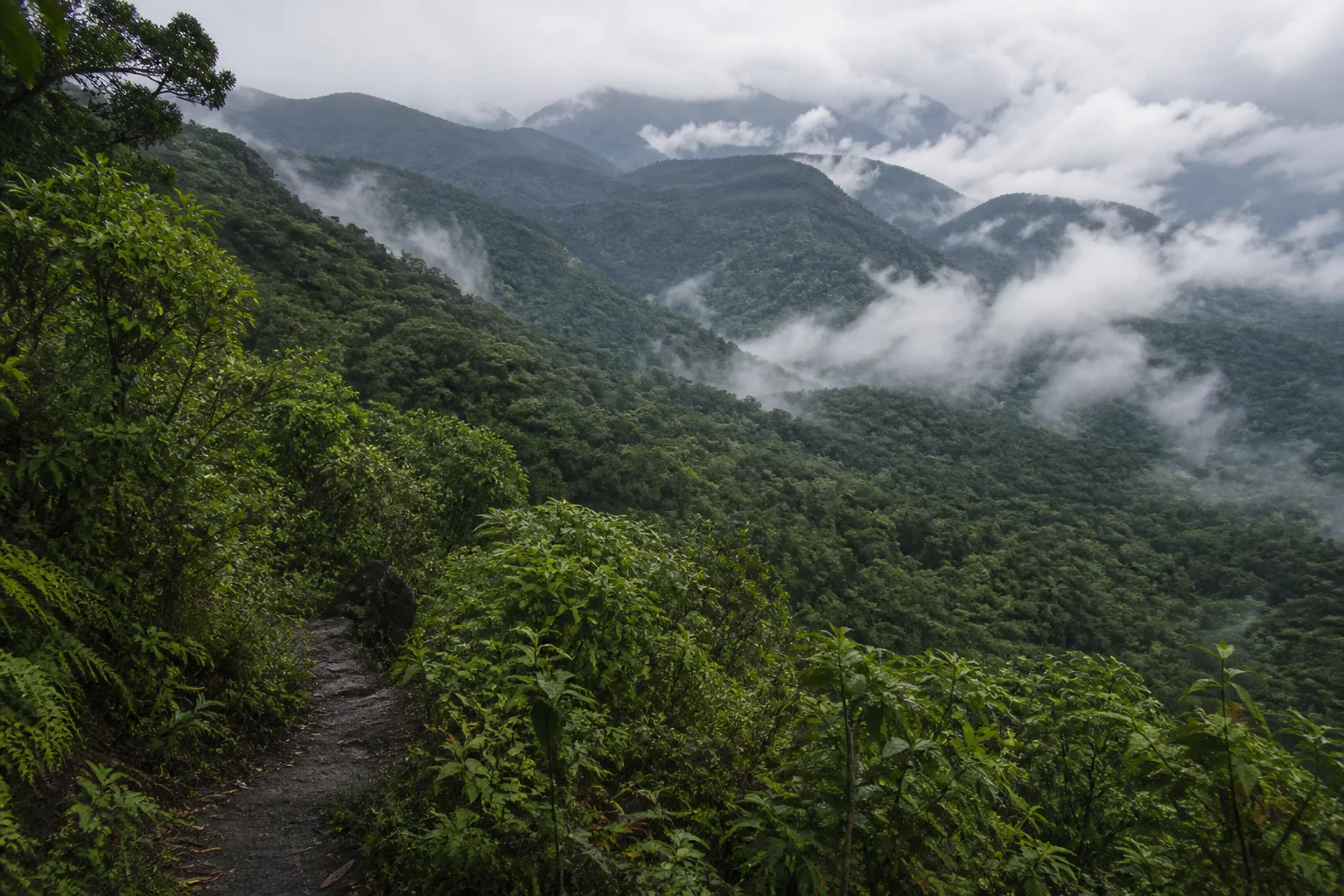
From Tenkasi, the Western Ghats are not a distant horizon. They form the region's western wall and influence rainfall, streams, vegetation, agriculture and transport toward Kerala. This mountain-edge setting helps explain Courtallam's misty seasonal identity and the distribution of reservoirs and cultivated foothills elsewhere in the district. It does not mean that every green slope is open forest, a trekking route or a protected-area visitor zone.
Protected-area and forest terminology requires precision. Reserve forest, wildlife sanctuary, tiger reserve and UNESCO World Heritage component are not interchangeable labels, and boundaries may not match what a visitor sees from a public road. This article does not disclose wildlife locations or imply access. The Western Ghats guide provides the broader ecological frame; on the ground, travellers should remain on authorized routes and follow current forest and district instructions.
Sources for this section: Courtallam, Tenkasi District.
Saral describes an atmosphere, not a forecast
Courtallam is strongly associated with saral, the fine wind-driven drizzle and mist that shape its popular seasonal image. The district has also used Saral Festival programming to celebrate this identity. A festival held in one year does not establish future dates, and a regional weather word does not guarantee continuous drizzle. Both belong to the relationship between mountain weather and cultural expectation, but operational details must remain dated.
This distinction helps visitors plan without losing the poetry of the place. It is reasonable to understand Courtallam through cool spray, cloud and seasonal gathering; it is not reasonable to promise those conditions on a booked weekend. Check forecasts and event notices shortly before travel, bring suitable footwear and rain protection, and keep an alternative plan. Tenkasi's temple streets, food and district landscapes still provide meaningful context when waterfall access changes.
Sources for this section: Tenkasi tourism, Tenkasi District.
Plan a connected route with a current-information checkpoint
A balanced regional visit can begin in Tenkasi's centre, continue toward Courtallam's public areas and then widen to a lawful viewpoint or another district place. The sequence should remain flexible rather than forcing every named fall into one day. Traffic, rain, crowd management and forest restrictions can alter the useful order. Maps help establish relationships, but they do not override gates, signs or local authority directions.
Before departure, check weather warnings, waterfall access, temple arrangements and transport with the relevant official source. On site, avoid slippery edges, strong flow and informal bathing points; keep waste out of watercourses; and do not enter restricted forest. The region rewards this restraint. Tenkasi and Courtallam become more than separate attractions when the temple town, sacred water, mountain wall and seasonal public life are understood as parts of one landscape.
Sources for this section: Tenkasi famous falls, Tenkasi tourism.
Sources & Further Reading
These authoritative references support the historical, geographic, or seasonal context in this story. Current conditions and operating details still require a fresh official check.
- Tenkasi District · Tenkasi District Administration
- Tourism · Tenkasi District Administration
- Coutrallam · Tenkasi District Administration
- Famous Falls · Tenkasi District Administration
- Arulmigu Kutraalanatha Swamy Temple, Kutraalam · Tenkasi District Administration
- Arulmigu Kasiviswanathaswamy Temple, Tenkasi · Tamil Nadu Hindu Religious and Charitable Endowments Department
Related Stories
Why Tamil Nadu Has Two Monsoon Seasons: Southwest and Northeast Rain Explained
A geographic explanation of why Tamil Nadu's rain story differs from much of India, and why coast, interior and western hills cannot share one seasonal rule.
From the Western Ghats to the Eastern Ghats: Reading Tamil Nadu's Mountain Landscapes
A comparative journey through Tamil Nadu's high western wall and broken eastern ranges, connecting mountains with monsoon, habitats, settlement and travel.
Tamil Nadu in the Late Southwest Monsoon: Where to Travel in August and September
A weather-aware way to choose between Tamil Nadu's hills, heritage cities, waterfalls, and coast during August and September.
Podhigai Malai Eco Trail: What the 2026 Budget Proposal Means
A careful guide to the Union Budget's Podhigai Malai nature-trail proposal, the landscape around it and why an announcement is not an access permit.
Editorial attribution
Prepared and reviewed by My Tamil Nadu Editorial Desk. Modified 24 August 2026.