
Coasts, communities and connected institutions
Christian and Islamic Communities in Tamil Regions
Ports carried people and books as well as goods. Christian and Muslim histories reveal changing communities, local languages and institutions across the Tamil regions.
Orientation
Overview
Medieval maritime settings to colonial-era institutions
Christian and Muslim histories in the Tamil regions cannot be told simply as the arrival of two religions from elsewhere. Arrival, settlement, conversion and the formation of institutions are different processes. Merchants could visit a port without founding a permanent community; a community could grow through local relationships as well as migration. A church, mosque or school might later connect that place with a much wider network.
The surviving records are uneven. Early Christian traditions place the apostle Thomas in southern India, while later documents make particular Christian communities and institutions more visible. Muslim histories include maritime connections, regional social identities and forms of learning in Tamil as well as other languages. Neither should be reduced to a single foreign origin or treated as a uniform population. This paired guide follows evidence, institutions and historical change, leaving detailed theology and current religious practice to other kinds of account.
How to read this guide
Different evidence, different questions
These categories are used throughout the article. A tradition can be historically important without independently proving the earlier event it describes.
Archaeology
Objects, structures and their excavated contexts.
Inscriptions
Words recorded on stone, metal or other material.
Literature
Composition, genre, argument and textual transmission.
Institutional records
Grants, catalogues, accounts and administrative arrangements.
Later tradition
Retrospective narratives, sacred memory and lineage claims.
Scholarly interpretation
Explanations built by comparing evidence, with room for revision.
Chronology
A careful timeline
These entries distinguish dated records, broad historical phases and later transmission. Dates of texts, objects and traditions need not coincide.
Thomas and Mylapore
The origin tradition and early modern debates about relics must be studied as different kinds of evidence.[1]
Merchants and political relationships
Scholarship follows Muslim merchant participation in Coromandel trade and administration.[7]
The Danish-Halle mission
Ziegenbalg and Plutschau arrived at Tranquebar; its records later connected Tamil institutions with European archives.[3]
Tamil New Testament in print
The archival guide records publication at the Tranquebar mission press.[5]
A Nagore connection in Singapore
The National Heritage Board dates the construction of Nagore Dargah there to these years.[11]
Historical reading
Reading communities through more than one archive
Archaeology and surviving buildings establish material settings, but an old foundation is not necessarily dated by its present walls. Inscriptions can identify a donor, burial or transaction. Literature preserves argument, narrative and religious vocabulary. Institutional records document schools, missions, gifts and administration. Later tradition supplies remembered origins and sacred biographies. Scholarly interpretation connects these sources, ideally explaining where an inference goes beyond their explicit wording.
Each archive also has a point of view. A mission letter was written for a recipient and a purpose, perhaps to seek resources or explain a difficulty. A merchant record could describe business while saying little about worship. A shrine narrative might organise memory around a saint. None is useless because it is interested, but none should be made to answer every question. Comparing them gives a community more historical depth than repeating one foundation account.
Historical reading
Thomas, Mylapore and the history of a tradition
The association of the apostle Thomas with Mylapore is a religious tradition of great importance to Christian memory. Historical examination asks when particular versions were recorded and how they were used. Liam Matthew Brockey’s study concerns early sixteenth-century Portuguese claims about Thomas’s relics, debates over their authenticity and the interaction of South Asian and European accounts. It treats those debates as part of early modern religious and imperial history.[1]
That framing avoids two shortcuts. The existence of a later shrine does not by itself verify every event in an apostolic narrative. Equally, uncertainty about the earliest narrative does not erase the later history of the people who maintained the shrine or visited it. The tradition had historical consequences through patronage, pilgrimage and claims to authority. Those consequences can be investigated without assigning an unverified first-century date to a surviving building.
It is also necessary to distinguish the Tamil coast from the Malabar coast. Communities and traditions crossed regional boundaries, but a record concerning one place cannot automatically be transferred to another. The proper unit of analysis may be a specific church, family, traveller’s account or manuscript. A broader southern Indian connection is valuable context; it is not a substitute for local evidence.
Historical reading
Christian communities within a changing social landscape
Susan Bayly’s study of southern India examines Christians and Muslims together through oral, literary and archival evidence. Its chapters include the Christian Paravas of southern Tamilnad and Christianity in the hinterland. Her interpretation places religious identification within wider social and political relationships rather than treating conversion as an event that removed people from regional society.[2]
This approach is particularly useful on the coast, where work and political protection could matter alongside religious affiliation. A history of the Paravas must keep the community visible, rather than making it merely the setting for a missionary biography. Questions about households, fishing, trade, leadership and patronage belong beside accounts of baptism and church organisation. The reasons given by outsiders may not exhaust the reasons people themselves had for acting.
Nor should Christian experience be flattened into a single colonial category. A history organised only around Europeans risks obscuring local teachers, translators and congregations. A history that assumes complete separation from local society misses continuing connections of language, kinship and social position. The records need to be read for both institutional affiliation and the relationships that continued across its boundaries.
Historical reading
Tranquebar: a mission assembled through connections
The Francke Foundations place the arrival of Bartholomaeus Ziegenbalg and Heinrich Plutschau at Tranquebar in 1706. Their account describes the learning of Tamil and Portuguese, the establishment of schools and the collection of letters, objects and palm-leaf manuscripts. It is particularly useful as a description of the mission’s own historical collections and transregional network. It should not be treated as a neutral verdict on the society the missionaries encountered.[3]
A mission was an organisation with supplies, correspondence and people performing different tasks. Translating a religious work required decisions about vocabulary and readers; running a school required negotiation with families as well as instruction. The European names that appear on published title pages are therefore only one route into the history. The local knowledge needed to make a text intelligible and the labour needed to produce it also belong in the account.
The peer-reviewed Tranquebar collection published by the Madras Institute of Development Studies brings schooling, print and social conflict into the same field of study. Its education chapters examine encounters with Tamil parents rather than assuming that the aims of a mission and the wishes of families always coincided. Institutional expansion could offer opportunities while also generating disagreement about authority, upbringing and religious commitments.[4]
Historical reading
Print did not end the life of manuscripts
The MIDA guide to the Francke mission archives records the Tamil New Testament printed at Tranquebar in 1715. It describes a press producing religious translations alongside grammars, dictionaries, schoolbooks, calendars and work commissioned by colonial administrations. Printing thus served several institutional purposes; its history cannot be reduced to the arrival of a machine or a claim that one mission invented Tamil literacy.[5]
A catalogue entry for Benjamin Schultze’s letter of 12 August 1721 gives a more concrete glimpse of this working network. It lists printing and paper matters, news of a school at Cuddalore, printed material being sent and further printing plans. The entry is evidence for the subjects of correspondence; without reading the manuscript itself, it does not support a detailed reconstruction of the conversation or every project’s completion.[6]
Manuscripts, oral instruction and printed books could belong to the same intellectual world. A printed text still needed readers and explanations; an unfamiliar term needed an agreed meaning. The history of print is therefore also a history of mediation. Comparing editions, translations and teaching material can reveal changes in intended audience that a simple list of publication dates would miss.
Historical reading
Muslim merchants and the Coromandel world
T. Anas Babu’s study of Taqi al-Din al-Tibi examines a Muslim merchant’s connections with trade and administration on the Coromandel coast. Its argument is that Arab and Persian commercial actors participated in state-building and religious networks as well as exchange. The individual career offers a way to study overlapping economic and political roles without treating every merchant as an agent of a single empire or religious programme.[7]
The distinction between Arab contact and Islamic history is essential. Arabia and the Indian Ocean were connected before Islam, so evidence of an early voyage or imported object cannot alone establish a Muslim community. For later periods, a burial inscription, named resident or documented religious endowment supplies a different kind of evidence from a commodity’s origin. Settlement requires attention to people and institutions, not just the movement of ships.
Kayalpattinam and Kilakarai belong within this coastal history, but their modern communities should not be imagined as unchanged remnants of one founding migration. Ports acquired significance through changing routes, markets and political relationships. The trade hub provides the wider maritime setting; the question here is how particular communities established and sustained local lives within that connected world.
Historical reading
Mosques, inscriptions and social history
J. Raja Mohamad’s Government Museum study brings inscriptions, colonial archives and Tamil literary material into the history of Coromandel Muslims. Among its examples is a sixteenth-century Kayalpattinam inscription concerning the difficulties caused by marriage payments. Such a record makes community concerns visible beyond trade. It is evidence for an articulated problem and response, not a statement about all Muslim marriages across every period.[8]
Mosques can be approached in the same precise way: identify which phase of a building is being discussed, which inscription belongs to it and what a gift actually supported. The date of a repair may be secure while the original foundation remains uncertain. A later local history may preserve a founder’s name without independently establishing the founder’s lifetime. These distinctions allow a mosque’s documented history and its remembered origins to be presented together without confusing them.
The museum study’s focus on the period 1750–1900 also warns against allowing medieval trade to stand for all later Muslim experience. Its source base includes commercial and administrative material as well as religious literature. That range encourages questions about adaptation under changing regimes and the different occupations through which people remained connected to coastal society.[8]
Historical reading
Tamil, Arabic script and intellectual exchange
Torsten Tschacher’s research examines Tamil written in Arabic script and the changing labels Arabic-Tamil and Arwi. His analysis cautions against assuming that a distinct script always meant that writers understood themselves to be using a separate language. Nineteenth-century texts could simply call their language Tamil. The terminology itself has a history and should not be projected backwards as an unchanging communal category.[9]
His university-hosted study also points to the value of these texts for questions beyond language, including social customs and scholarly networks across the Indian Ocean. Poetry and religious prose can disclose what writers wished to teach, debate or reform. They are literary evidence with particular audiences; they do not automatically describe what every reader did.[10]
This makes intellectual history more than a catalogue of borrowed words. A manuscript in one script and a printed edition in another may circulate a related teaching to different readers. Translating a concept requires choices, and commentary can preserve disagreement about those choices. Such work belongs to Tamil literary history even where its authorities and vocabulary connect with a wider Islamic world.
Historical reading
A religious connection carried across the sea
Singapore’s National Heritage Board records a Tamil Muslim mosque initiative in 1827 and dates the Nagore Dargah there to 1828–1830. These documented nineteenth-century developments show how migrants carried institutional and sacred connections from the Coromandel coast into a new urban setting. They do not date the origins of Islam in Tamil Nadu, but they make one later maritime connection concrete.[11]
The example also changes the direction of the story. The Tamil coast was not only a place receiving religious influences; it was a point from which people, texts and forms of association travelled. A network can be studied through its local institutions at both ends. Doing so brings migration into religious history without assuming that moving overseas dissolved regional ties or created a single identical diaspora community.
Historical reading
Comparison without collapsing the differences
The Christian and Muslim examples share useful historical questions: how a community was recorded, how institutions were supported, how texts travelled and how local relationships shaped wider affiliations. Their timelines and sources are nevertheless different. A mission archive, mosque inscription and saint’s biography cannot be placed on one evidential scale without considering why each was produced and whose voice it preserves.
Neither a story of effortless coexistence nor one of permanent conflict can carry this history. Cooperation, inequality, rivalry and adaptation have to be demonstrated in particular settings. The strongest next step is often local: a documented school, a dated endowment, a family’s correspondence or a manuscript with a recoverable history. These smaller histories allow the larger account to remain plural without becoming vague.
Human scale
People and institutions
Named rulers are only one part of the history. These groups and individuals help show how evidence and social life connect.
Merchants and migrants
Commercial routes could support settlement, patronage and institutional connections.
Teachers, translators and readers
Religious literature depended on local languages and acts of interpretation.
Families and congregations
Institutions developed through community decisions as well as external sponsorship.
Historical geography
Connected places
Explore the landscapes and settlements discussed in this guide.
Questions
Frequently asked questions
Is the Thomas tradition treated here as proven first-century history?
No. Its religious importance and later historical uses are distinguished from independently dated evidence.
Does Arab trade automatically prove an early Muslim settlement?
No. Trade before Islam and later Muslim communities must be distinguished; settlement needs evidence concerning people and institutions.
Was Arwi simply a separate language from Tamil?
Scholarly work shows that terminology and script use changed. Many writers described the language as Tamil even when using Arabic script.
Editorial trust
Sources and further reading
Citations in the article point to this full list. Source type and review date are shown so readers can evaluate the evidence.
- 1Liam Matthew Brockey, Doubting Thomas: The Apostle and the Portuguese Empire in Early Modern Asia (2012)Oxford University PressAcademic chapter; public abstract on Mylapore relics and historical claims · Reviewed 17 November 2026
- 2Susan Bayly, Saints, Goddesses and Kings: Muslims and Christians in South Indian Society, 1700–1900Cambridge University PressAcademic monograph; publisher description and chapter structure · Reviewed 17 November 2026
- 3Historical Networks: the Danish-Halle missionFrancke FoundationsInstitutional archive description; own mission collections and chronology · Reviewed 17 November 2026
- 4Indo-Danish Cultural Encounters in Tranquebar: Past and Present (2009)Madras Institute of Development Studies / National Museum of DenmarkPeer-reviewed special issue; schooling and printing articles · Reviewed 17 November 2026
- 5The Mission Archives in the Archives of the Francke Foundations in HalleMIDA / Francke Foundations archivesScholarly archival guide; indexed description of records and printed works · Reviewed 17 November 2026
- 6Benjamin Schultze letter from Tranquebar, 12 August 1721, AFSt/M 1 H 2:32Francke Foundations / Kalliope Union CataloguePrimary archival record; catalogue summary, not full manuscript transcription · Reviewed 17 November 2026
- 7T. Anas Babu, When imarat and tijarat combined: The varied career of Taqi al-Din al-Tibi on the Coromandel Coast (2025)International Journal of Maritime HistoryPeer-reviewed maritime history; publisher abstract consulted · Reviewed 17 November 2026
- 8J. Raja Mohamad, Maritime History of the Coromandel Muslims (2004)Government Museum, ChennaiInstitutional research monograph; full text, epigraphic discussion and source list · Reviewed 17 November 2026
- 9Torsten Tschacher, From script to language: the three identities of Arabic-Tamil (2017)South Asian History and CulturePeer-reviewed textual study; article text consulted through author copy · Reviewed 17 November 2026
- 10Torsten Tschacher, Islam in Tamilnadu: Varia / Arwi discussionMartin Luther University Halle-WittenbergUniversity-hosted academic study; indexed passages consulted · Reviewed 17 November 2026
- 11From the Coromandel Coast to the Straits: Revisiting Our Tamil HeritageNational Heritage Board, SingaporeInstitutional heritage research; indexed mosque and shrine dates · Reviewed 17 November 2026
Editorial review: Reviewed 17 November 2026 using accessible archaeological records, published inscriptions, institutional summaries and scholarly research. Some full publications were unavailable; abstracts and indexed excerpts support only the specific claims discussed, while the publications also provide further reading. Dates and interpretations retain their stated uncertainties.
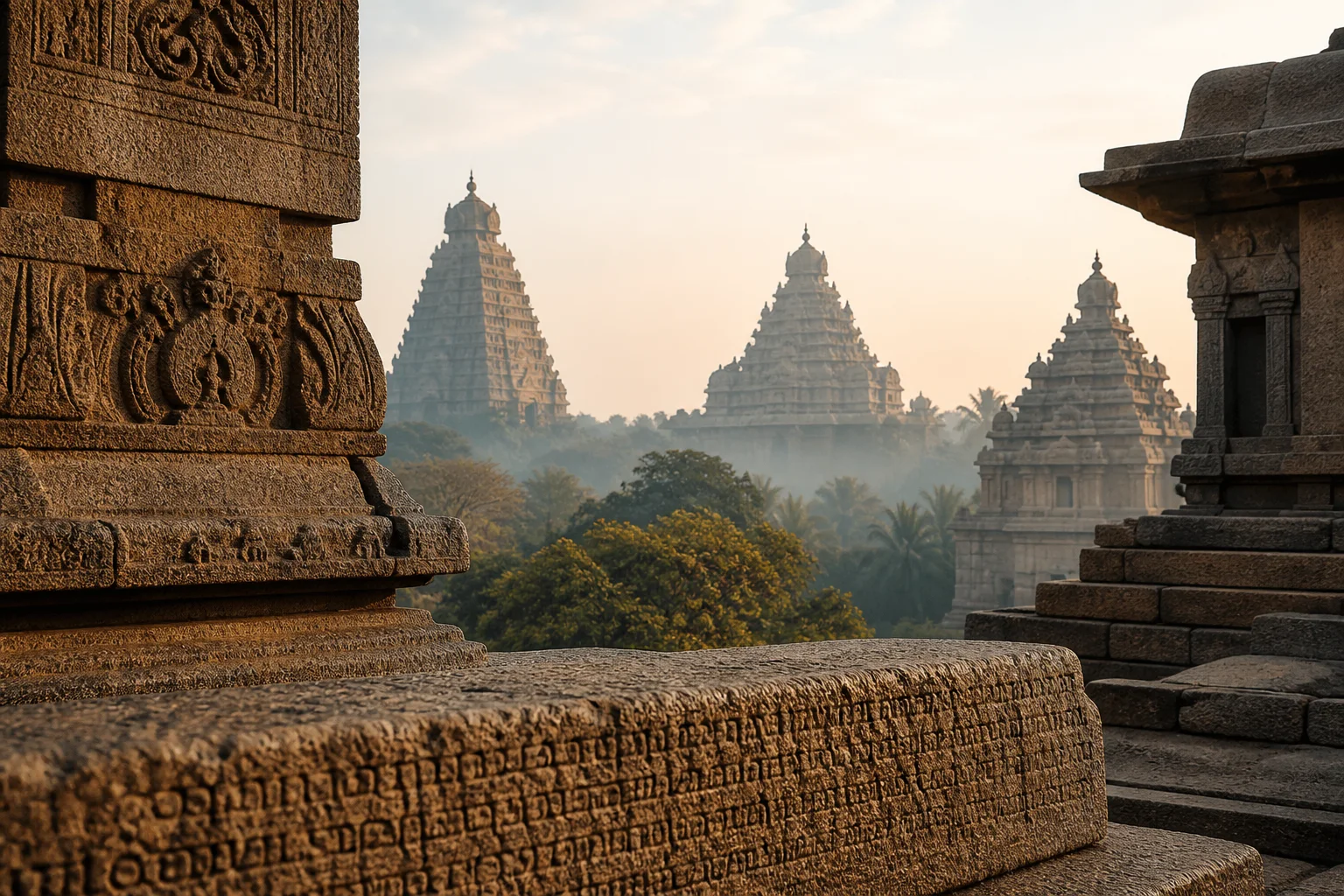
A Journey Through Chola Heritage in Tamil Nadu
Follow a thoughtful route through three living Chola temple landscapes, learning to read architecture, inscriptions, patronage, and place without rushing.
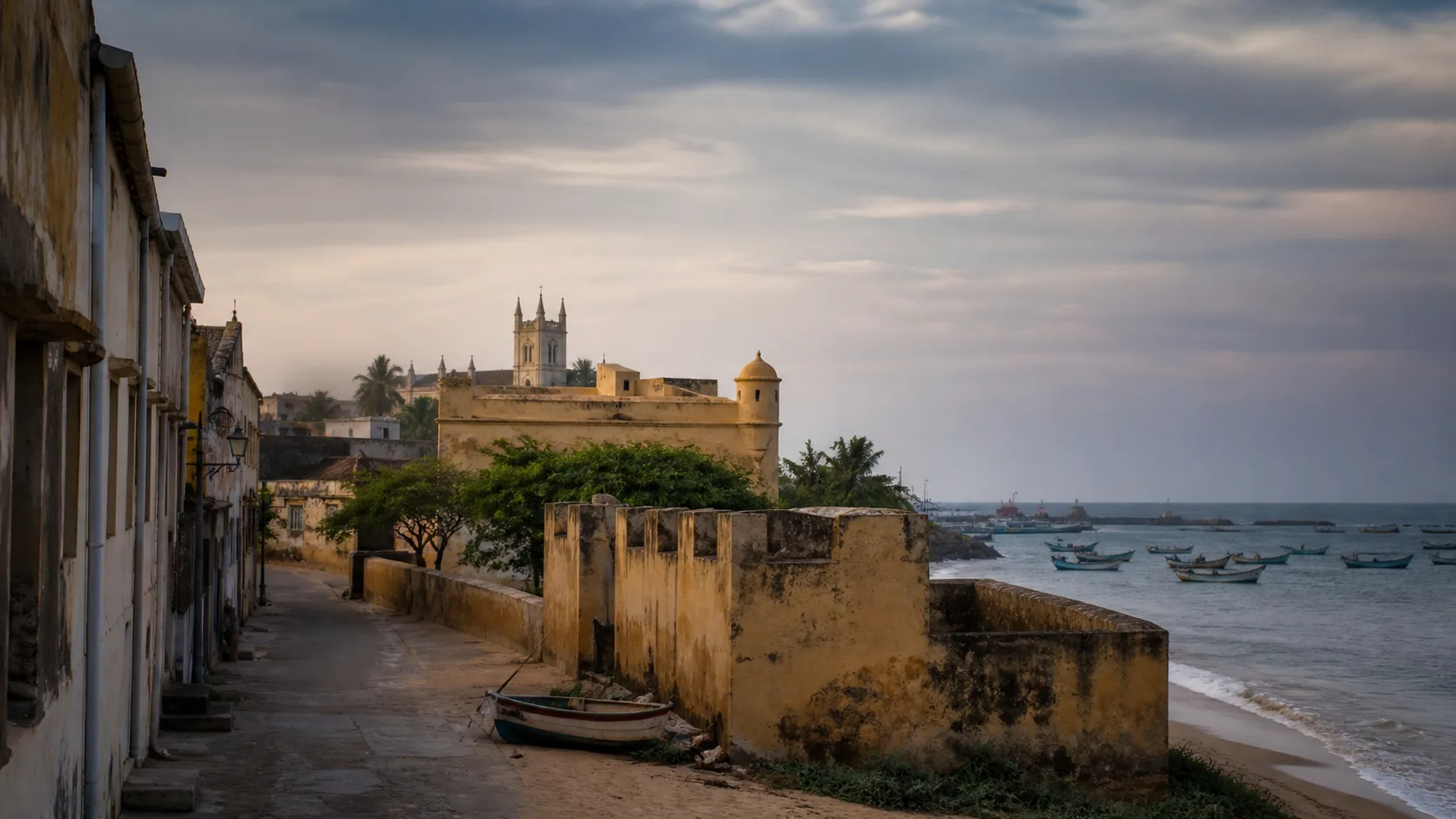
Tharangambadi: Read the Fort, Printing History and Living Coast
A layered coastal-town guide that begins before the Danish fort, follows trade and printing history, and returns heritage to a living Bay of Bengal shoreline.

Mamallapuram: Read a Coastal World Heritage Landscape
A connected reading of Mamallapuram that moves from granite outcrops and carved caves to monolithic experiments, open-air reliefs, the Shore Temple and a living coastal town.