
History beyond the royal court
Water, Agriculture and Everyday Life
Follow water from a catchment to a field, and a harvest into households, workshops and temples. The landscape reveals a history of skilled work, negotiation and unequal access.
Orientation
Overview
Early farming, medieval institutions and later transformations
A field needs more than rain. Seed has to be kept, ground prepared, a crop tended and the harvest carried, stored and divided. Where water is brought from elsewhere, cultivation also depends on work beyond the field: an inlet kept clear, a bank repaired or a release timed so that water reaches the intended plots. These tasks make agriculture a useful starting point for a history of people who rarely appear in accounts organised around kings and battles.
They also connect places that a modern visitor might experience separately. A temple wall records a gift; a tank retains water; a workshop produces objects for exchange. Read together, these places raise questions about the resources that sustained religious service, craft production and settlement. Who cultivated the endowed land? Who maintained the supply? Who received the income? Following those connections gives the landscape social depth without turning every surviving structure into the work of a single ruler.
This guide moves between early crop evidence, medieval inscriptions and later environmental history. It keeps their scales distinct. A seed assemblage can illuminate food plants at an excavated settlement, while an assembly inscription describes a particular institution and its rules. Neither represents every household in the Tamil region. The most rewarding comparisons preserve those differences: between river-fed fields and rain-dependent cultivation, between named donors and unnamed workers, and between the same waterbody under changing forms of authority.
Land, water and work
A settlement depends on relationships
Where water reaches
Rainfall, soils, slopes, rivers and storage set different possibilities for cultivation.
Who keeps it working
Growing crops and maintaining channels require recurring work, tools and resources.
Who makes the decisions
Control of land, revenue and institutions affects access to water and the value of a harvest.
Regional differences
Three landscapes, different questions
Riverine and delta settings
How did channels, settlements and agricultural land relate to a changing river?
Tank-irrigated settings
Who maintained storage and outlets, and how were access and obligations recorded?
Rainfed and pastoral settings
How did cultivation, grazing and seasonal movement fit alongside irrigated land?
These are comparisons to investigate, not rigid zones or three fixed ways of life. The following sections trace the evidence and its chronology.
Chronology
A careful timeline
These entries place crop evidence, recorded institutions and later studies in time. They do not establish a single origin date for farming or irrigation.
Cultivation before royal inscriptions
Paiyampalli provides charred pulse evidence within its Neolithic occupation.[1]
Several crops and working economies
Plant studies at Mangudi, Kodumanal and Perur reveal differing crop assemblages.[2]
Rules at Uttiramerur
Parantaka I inscriptions describe committee selection in a Brahmin settlement.[3]
A monumental temple economy
The consecration of Thanjavur’s Brihadisvara belongs to this period.[7]
Changing water institutions
Colonial management, environmental change and irrigation finance alter the questions around land and water.[6][8][9]
Historical reading
Several agricultural landscapes, not one village story
The Kaveri valley is prominent in histories of Chola power, but its irrigation cannot stand for all Tamil agriculture. IGNOU’s account contrasts the valley’s embankments and connected canals with northern Tamil areas where large reservoirs and local assemblies played a substantial role. It describes support from rulers, chiefs and territorial institutions alongside settlement organisations. Agricultural development therefore involved several kinds of investment and authority rather than a simple choice between royal engineering and village initiative.[10]
A river-fed channel and a reservoir storing seasonal runoff solve different problems. One directs flowing water; the other holds a supply for later use. Their fields depend on the position of inlets, outlets and cultivated ground, not simply on the amount of water visible from a road. A full tank above one settlement may have obligations to fields farther away. A river nearby is not, by itself, proof that every household can irrigate its land.
The distinction between wet and dry land also needs room for change. In his study of nineteenth-century Tamilnad, Prasannan Parthasarathi argues that a narrow focus on irrigated and unirrigated fields obscures the wider environment. Forest, grassland and scrub helped support cultivation and rural wellbeing. Land described administratively as waste could still supply resources. These connections matter when comparing a cultivated plot with the surrounding land: the uncropped spaces were not necessarily economically empty.[6]
Historical reading
What seeds bring into view
At Paiyampalli in northern Tamil Nadu, charred horse gram and green gram are part of the evidence used to identify Neolithic agriculture. Pondicherry University’s archaeological synthesis places these finds within the excavated settlement record. They take the story of farming beyond the periods best known from inscriptions. They also put pulses, rather than rice alone, at the beginning of this discussion. The surviving grains are evidence of particular plants; they are not a complete menu or a measurement of the area cultivated.[1]
A study by Miriam Cooke, Dorian Fuller and K. Rajan examined botanical material from Mangudi, Kodumanal and Perur. Perur yielded a varied assemblage with rice, millets and pulses, while Kodumanal included cotton seeds and other crops. The authors interpret differences between the sites as evidence against a uniform agricultural economy. Their discussion links cotton with craft activity and treats irrigation requirements as an inference from cultivation, rather than identifying an excavated canal for every crop-bearing deposit.[2]
These findings change how an inland settlement can be imagined. A place known for ornaments may also have been involved in growing fibre; a settlement with rice need not have abandoned other crops. Food production and manufacture can occupy the same historical picture. The practical question becomes how people arranged work across activities, rather than whether a place should receive the single label of farming village or craft centre.
The route into this earlier history is through deposits, samples and comparison. A charred seed survives because of particular circumstances of burning and burial. Its presence is valuable, but its absence elsewhere may reflect preservation or recovery. For a reader, the useful result is a grounded list of plants and a set of differences between sites. It is less dramatic than a claim to the first cultivation of an entire region, but far more revealing about actual settlements.
Historical reading
Keeping water moving was recurring work
The working parts of an irrigation system have different jobs. A catchment supplies runoff, a reservoir stores it, a sluice regulates release and a channel carries it towards fields. A surplus outlet must allow excess water to escape without destroying the bank. These relationships explain why a tank is more than an expanse of open water. The companion eri guide follows those parts in detail; here they establish the setting in which labour and decisions had to meet.
Construction is only one episode in that setting. Storage becomes less useful if water cannot enter, and an open outlet achieves little if a downstream channel is obstructed. Maintenance therefore has a geography: work at one point changes what is possible somewhere else. When considering an inscription about an endowment or a repair, it is worth asking which part of the system it supported and who depended on that part. The largest visible structure need not have been the only important one.
A present-day study of fourteen linked tanks in the Mailam area of Villupuram offers a clear example of the connected scale. Rengalakshmi and colleagues examine a cascade in the catchment upstream of the Kazhuveli wetland, including changing uses and groundwater relationships. This is contemporary research, not a date for the tanks’ origins. Its relevance here is practical: waterbodies that look separate on a journey can function as parts of a larger landscape. That helps explain why historical maintenance cannot always be understood within a single village boundary.[11]
Historical reading
Uttiramerur: organisation with restricted membership
The Uttiramerur inscriptions of 919 and 921, under Parantaka I, are unusually detailed evidence for local administration. The UGC teaching module discusses annual, garden and tank committees, with selection through the kudavolai or pot-ticket procedure. These were rules for a sabha in a Brahmin settlement. Eligibility involved property, age and religious learning; it was not universal participation by all residents. The texts show organised responsibilities and selection procedures within a socially restricted institution.[3]
That combination is historically more interesting than either praise or dismissal. A committee could have a defined task and procedures for choosing members while excluding most people whose work sustained the settlement. Administrative sophistication and social inequality are compatible. Someone responsible for cultivating a field, carrying materials or repairing a channel was not necessarily eligible to sit among those who supervised its resources.
The physical scale of work and the social scale of decision-making should therefore be read separately. A record of named officeholders makes authority unusually visible; it does not list everyone affected by their decisions. Nor should the detailed regulations of Uttiramerur be exported automatically to settlements with different institutions. Used locally, the inscriptions reveal how one important assembly organised responsibility. Used as a constitution for all Tamil villages, they conceal precisely the variation a history of everyday life needs to explain.
Historical reading
Land, produce and the power to claim a share
Land can appear in a record as a boundary, a gift, a sale, a source of income or an obligation. Those descriptions should not be collapsed into one modern idea of ownership. A donor’s recorded act and a cultivator’s work concern the same field but different relationships to it. To understand a transfer, the useful questions are concrete: what was transferred, what income followed it, what obligations continued, and which people or institutions recognised the arrangement?
Dharma Kumar’s study of medieval South Indian property draws attention to differing rights and their transactions. Its accessible notes include Pandya inscriptions recording temples’ sales of karanmai rights, while cautioning against assuming that these rights were invariably saleable. The terminology points to distinctions that an English word such as landholding can flatten. It is better to retain the recorded category and explain the transaction than to assume every grant removed all other claims on a plot.[4]
This matters for understanding the harvest. Producing a crop and being entitled to dispose of all of it are different things. A historical account should follow obligations as carefully as yields: a field might be discussed because of what it supplied to a religious institution, rather than because a scribe wanted to describe the cultivator’s household. Reading for both relationships keeps the producer within the story even when the surviving document was made for the beneficiary.
Historical reading
A temple connected fields with many kinds of work
The Smithsonian’s account of Chola temples describes employment extending from priests to cooks and gardeners, alongside the work of builders, bronze makers, musicians and dancers. It also distinguishes costly gifts from wealthy patrons and more modest offerings such as lamps and flowers. A temple’s daily life required supplies and services as well as monumental architecture. Its economic history therefore includes recurring work and small donations, not just a king’s construction programme.[5]
Consider a lamp as a way into that history. As an object it belongs to metalwork and ritual; as a recurring service it raises questions about a continuing supply of fuel, responsibility for lighting and arrangements for support. The same exercise works with flowers or food offerings. The point is not to assign one universal payment system to every temple. It is to follow the movement from a donor’s stated purpose to the material work needed to fulfil it.
Thanjavur provides a firm monumental anchor. UNESCO places the consecration of Rajaraja I’s Brihadisvara temple in 1009–1010 and presents it alongside the later temples at Gangaikondacholapuram and Darasuram. Their differences allow comparison across Chola patronage rather than treating the dynasty as a single building moment. The surviving stone monuments are especially visible achievements; the land, provisions and working relationships around them require another kind of attention.[7]
Historical reading
Women’s initiative and unequal working lives
Women should enter this history as participants with different resources and positions. Leslie Orr’s study of temple women uses epigraphical evidence to examine their activities and identities in medieval Tamilnadu. The publisher’s account emphasises initiative, economic autonomy and involvement in temple politics; the book separately considers women as patrons and servants. This challenges an account in which women appear only as recipients of decisions made elsewhere. It does not establish that all women shared the opportunities of the donors who left records.[12]
A named gift can reveal someone’s capacity to act, but it cannot describe every condition of her life. Nor does a record of a woman’s contribution justify assigning all women the same occupational identity. The stronger approach is to keep the individual action visible: a donation, a claim to recognition or a place within an institution. Such details make room for agency without using a few recorded achievements to erase differences of wealth, status or access.
There are also records in which cultivators appear through the problem of protection. Kumar cites an inscription from Kulottunga III’s reign in which the Vallanadu assembly undertook to protect cultivators in a specified area. If an assembly member robbed a cultivator, a stipulated amount of irrigated land was to pass to a temple. The obligation and penalty reveal tension within the local order. They are not evidence that the promise was always kept.[4]
The example places inequality inside the history of institutions rather than outside it. An assembly could organise resources and still contain people from whom cultivators needed protection. Shared dependence on water did not automatically produce equal security. A useful account of rural cooperation must leave space for that tension, including the difference between a rule announced publicly and a household’s ability to make it effective.
Historical reading
Fields and workshops belonged to connected economies
Kodumanal makes a productive bridge to the trade pages. The Department of Archaeology records ceramics, beads, inscribed sherds and iron objects from its excavations. A burial assemblage included a large group of carnelian beads, alongside other grave goods. These finds show why an inland settlement belongs in an account of regional exchange, but a burial deposit and a workshop deposit answer different questions. Objects placed with the dead cannot simply be counted as the output of a day’s manufacture.[13]
The cotton evidence discussed by Cooke, Fuller and Rajan adds cultivation to that picture. Their study connects the crop with textile-related production and considers how differing crop choices might fit alongside craft work. This is a reason to connect agricultural and commercial histories, rather than ending one at the edge of the field and beginning the other at a port. The proposal concerns an economy’s organisation; it does not identify the grower of a particular surviving textile.[2]
The distinction helps frame ordinary exchange as well as distant trade. A craft worker needed provisions, while farming required containers and implements. The question is how those needs were met in a particular setting: through household production, obligations, local transactions or wider circulation. Imported goods attract attention because their origins can be distinctive, but the less conspicuous provision of food and materials is what makes a working settlement possible. The inland trade guide follows the archaeological evidence for those broader connections.
Historical reading
Colonial change and the landscape that survives
The nineteenth century introduced changes that cannot be treated as a footnote to medieval arrangements. David Mosse examines how colonial and later development institutions represented community management of tank irrigation. His argument is that local resource institutions become misleading when separated from their social and historical setting. The idea of an autonomous village maintaining its water through timeless cooperation is itself something to investigate, not a ready-made description of the past.[8]
The financing of large works also changed the terms of debate. Research in The Historical Journal connects nineteenth-century Madras irrigation projects with questions of water law, charges and repayment of investment. From the 1850s, officials’ concern with the ability to charge for water was tied to the funding and profitability of canal construction. Engineering plans therefore carried questions about authority and revenue as well as the movement of water.[9]
Parthasarathi’s environmental argument adds another change of scale. Agricultural productivity depended on resources beyond the cropped field, and alterations to forests, uncultivated land and water supplies changed the conditions of farming. A historical landscape is consequently neither a purely natural backdrop nor a finished engineering achievement. It is continually remade through use, maintenance, investment and competing claims.[6]
When visiting a tank, field landscape or temple today, begin with what can actually be seen: the lie of the ground, the direction of a channel, a repaired bank, a dated inscription or the relationship between a settlement and its water. Then ask which period each feature belongs to. The resulting history may cross several dynasties and later administrations. That layered view brings the monument back into the working landscape, where harvests, obligations and ordinary decisions gave it a life beyond its foundation date.
Human scale
People and institutions
Named rulers are only one part of the history. These groups and individuals help show how evidence and social life connect.
Cultivators and maintenance workers
The work of growing crops and keeping supplies usable connects the field with the wider irrigation system.
Donors and service workers
Temple records bring some patrons into view while service depended on many kinds of recurring work.
Assemblies and authorities
Local institutions and rulers shaped claims on resources; organisation did not imply equal participation.
Historical geography
Connected places
Explore the landscapes and settlements discussed in this guide.
Visual reading
A schematic water landscape
These project-created visuals support orientation. They are not presented as photographs of an excavation, monument, person, or event.
Questions
Frequently asked questions
Was Tamil agriculture always centred on rice?
No. Archaeobotanical studies identify pulses, millets, rice and cotton in differing assemblages. One site’s crops should not be treated as the diet of the entire region.
Did every resident participate in village assemblies?
No. The famous Uttiramerur procedures concerned a Brahmin settlement’s assembly and included eligibility restrictions. They were not universal suffrage.
Were tanks managed only by kings or only by villages?
Neither description is sufficient. Evidence identifies different roles for rulers, local institutions and other patrons, and those arrangements changed over time.
Editorial trust
Sources and further reading
Citations in the article point to this full list. Source type and review date are shown so readers can evaluate the evidence.
- 1Introduction to the Study of Archaeology: PaiyampalliPondicherry UniversityUniversity teaching text; excavation synthesis · Reviewed 17 November 2026
- 2Early Historic Agriculture in Southern Tamil Nadu: Archaeobotanical Research at Mangudi, Kodumanal and PerurGerman Archaeological InstituteMiriam Cooke, Dorian Q. Fuller and K. Rajan; primary archaeobotanical study, South Asian Archaeology 2003, pp. 341–350 · Reviewed 17 November 2026
- 3The Cholas: Provincial and Local AdministrationUGC e-PG Pathshala / INFLIBNETV. Selvakumar; academic teaching module, especially pp. 9–11 · Reviewed 17 November 2026
- 4Private Property in Asia? The Case of Medieval South IndiaCambridge University PressDharma Kumar, Comparative Studies in Society and History 27(2), 1985; accessible extract and inscription references · Reviewed 17 November 2026
- 5The Age of TemplesSmithsonian National Museum of Asian ArtMuseum interpretation of Chola temple patronage and employment · Reviewed 17 November 2026
- 6Water and Agriculture in Nineteenth-century TamilnadCambridge University PressPrasannan Parthasarathi, Modern Asian Studies 51(2), 2017; accessible abstract · Reviewed 17 November 2026
- 7Great Living Chola TemplesUNESCO World Heritage CentreInstitutional heritage description and chronology · Reviewed 17 November 2026
- 8Colonial and Contemporary Ideologies of “Community Management”: The Case of Tank Irrigation Development in South IndiaSOAS University of London / Cambridge University PressDavid Mosse, Modern Asian Studies 33(2), 1999, pp. 303–338; author repository copy · Reviewed 17 November 2026
- 9Indian Rivers, “Productive Works”, and the Emergence of Large Dams in Nineteenth-century MadrasCambridge University PressPeer-reviewed historical research; water law and irrigation finance · Reviewed 17 November 2026
- 10Early Medieval Economy and its ContinuitiesIndira Gandhi National Open UniversityUniversity history teaching publication; agrarian expansion and irrigation · Reviewed 17 November 2026
- 11Socio-hydrology and sustainable tank management: empirical case from a Mailam tank cascade, Tamil Nadu, IndiaFrontiers in WaterRengalakshmi and colleagues, 2025; present-day case study, not evidence of ancient dating · Reviewed 17 November 2026
- 12Donors, Devotees, and Daughters of God: Temple Women in Medieval TamilnaduOxford University PressLeslie C. Orr, 2000; publisher abstract and contents, not full-book access · Reviewed 17 November 2026
- 13Kodumanal: excavation summaryTamil Nadu Department of ArchaeologyOfficial archaeological site summary · Reviewed 17 November 2026
Editorial review: Reviewed 17 November 2026 using accessible excavation records, institutional summaries and scholarly research. Some full publications were unavailable; abstracts and indexed excerpts support only the specific claims discussed, while the publications also provide further reading. Dates and interpretations retain their stated uncertainties.

A Journey Through Chola Heritage in Tamil Nadu
Follow a thoughtful route through three living Chola temple landscapes, learning to read architecture, inscriptions, patronage, and place without rushing.
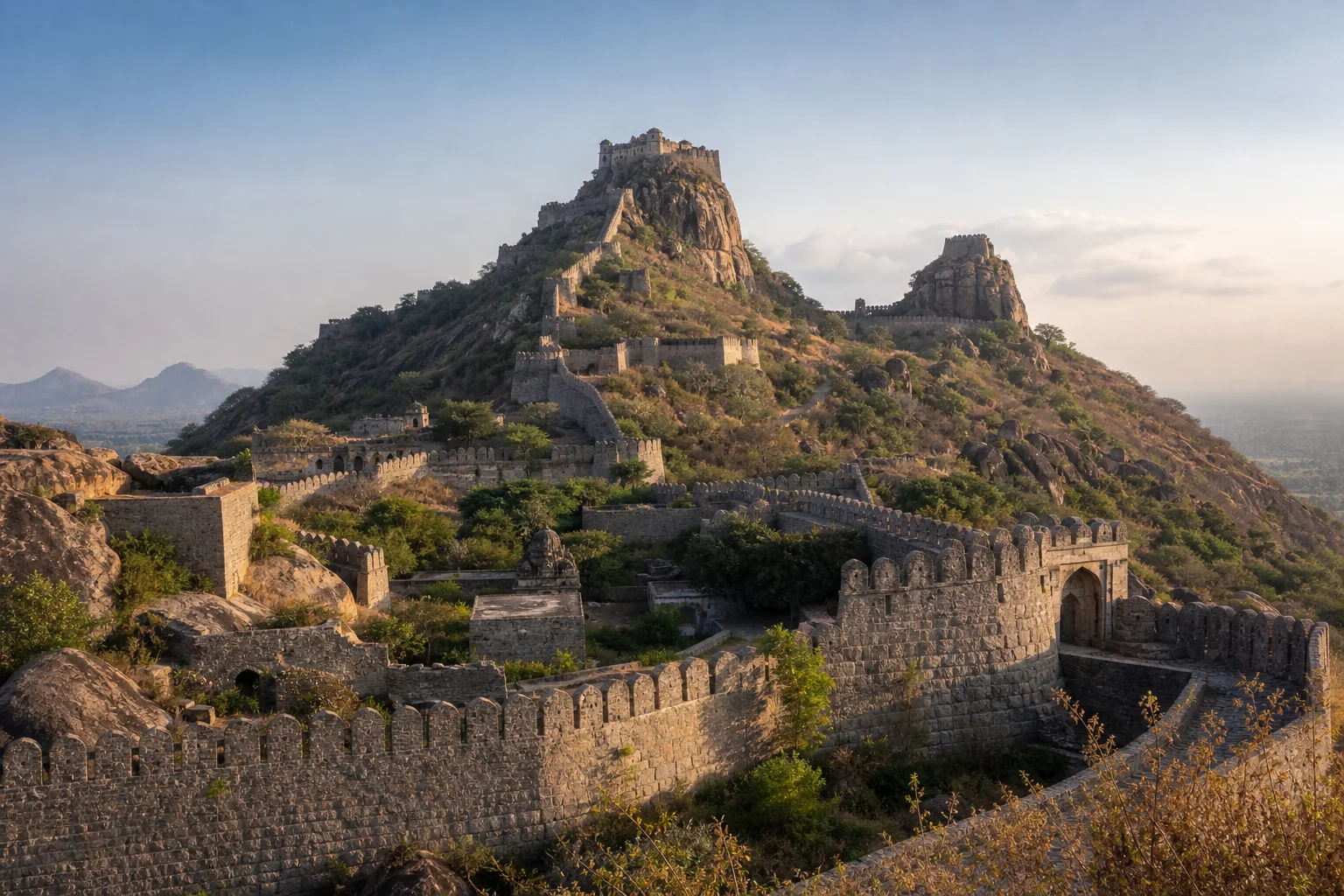
Gingee Fort After UNESCO: Reading a Military Landscape, Not Just a Ruin
What Gingee's place in a 12-fort World Heritage serial property means, and why its granite hills, walls, water and layered history must be read together.
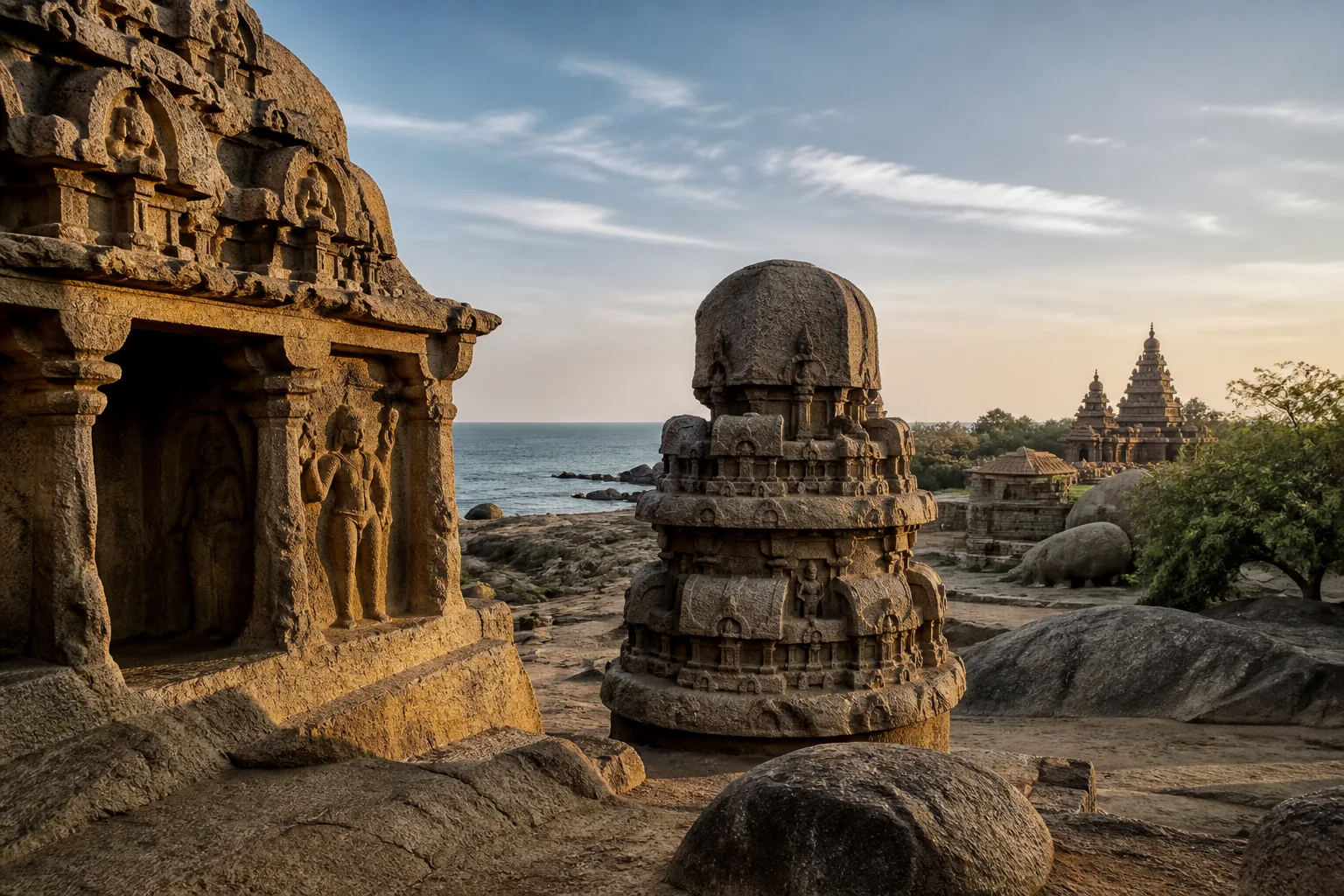
Beyond the Cholas: Exploring Pallava Heritage Across Tamil Nadu
Follow Pallava heritage from Kanchipuram's sacred city to Mamallapuram's coastal stone workshop, learning to compare form, material and evidence.