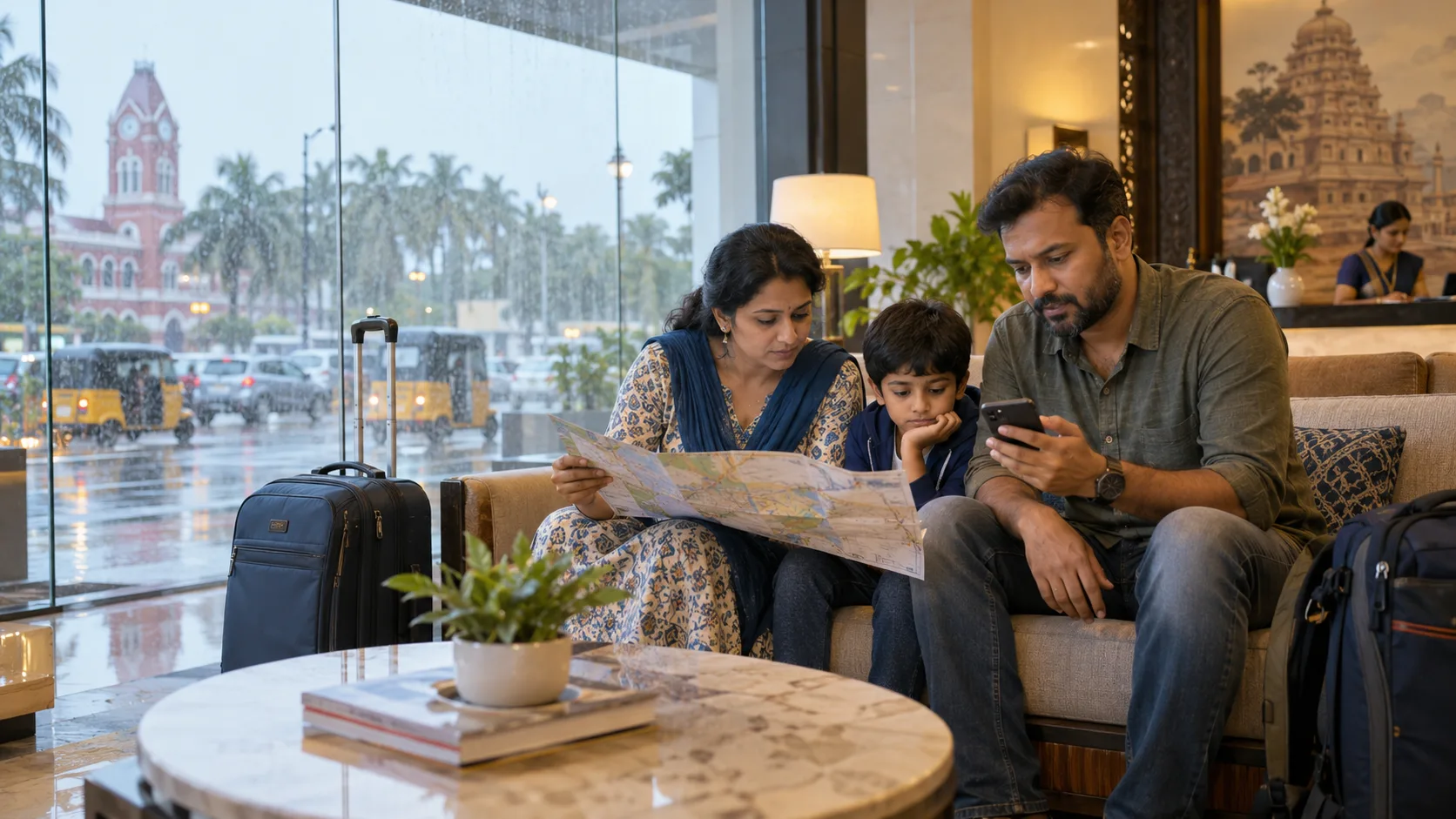
What changed on 15 October 2026
The India Meteorological Department said that the southwest monsoon withdrew from the entire country on 15 October 2026 and that northeast-monsoon rainfall activity began simultaneously over Tamil Nadu, Puducherry and Karaikal and several neighbouring regions. For Tamil Nadu travelers, that announcement marks the beginning of the state's principal October-to-December rain context. It does not mean that every district became rainy at the same time, or that one announcement describes the conditions for an entire holiday.
Monsoon onset is a seasonal classification. A travel decision still depends on the dated forecast, the district, the route and the activity. The Regional Meteorological Centre in Chennai publishes daily bulletins, district and subdivision warnings, nowcasts, fishermen warnings, coastal information, highway forecasts and city products. Those layers answer different questions. A multi-day warning can influence a booking decision; a nowcast can change the next few hours; a local authority or operator can close a road, trail, ferry or attraction even when the wider forecast looks manageable.
The practical response is neither panic nor complacency. Keep the trip flexible, identify the authority responsible for each vulnerable part and choose a decision time. Check once before the cancellation deadline, again before starting the long transfer and again before an exposed outdoor activity. A forecast is useful only when it is connected to a choice you can still change.
Sources for this section: RMC Chennai weather and warnings, 2026 monsoon transition, IMD district warnings.
How to read a warning without overreacting or ignoring it
Begin with location. A warning for one or more Tamil Nadu districts is more useful than a generic social-media post saying that the state will receive rain. Confirm that the place where you will sleep, the road you will use and the place you will visit are covered by the same bulletin. A Chennai hotel, a Mamallapuram monument visit and a drive farther south can sit under different local risks even when they belong to one itinerary.
Next, read the validity period and hazard. Heavy rain, thunderstorm, lightning, strong wind, rough-sea conditions and possible local flooding are not interchangeable. The effect also depends on exposure. A museum reached by a short urban transfer may remain a reasonable option while a waterfall approach, beach walk, hill road or low underpass does not. Do not reduce a color or icon to a guarantee that everything is open or closed; read the accompanying impact and action advice where available.
Finally, check for a newer product. Forecasts are updated as observations and model guidance change. Screenshots forwarded without an issue time can outlive the advice they contained. Use the live IMD page or the National Disaster Management Authority's SACHET portal, which distributes alerts from authorized government sources. If an operator claims that an exposed activity will continue despite an official warning, ask who controls the final access decision and choose the more conservative interpretation.
- Match the warning to the district, route and activity.
- Check the issue time and validity period, not only the color.
- Read the named hazard and expected impact.
- Look for a newer bulletin before departure.
- Follow closures and instructions from the responsible local authority.
Sources for this section: RMC Chennai weather and warnings, IMD district warnings, SACHET government alerts.
Use a three-check method before a rain-season trip
The first check happens before financial commitment. Prefer transport and accommodation with understandable change or cancellation terms. Record the deadline, fee and method rather than relying on a vague flexible label. Choose a base with food and indoor options nearby, especially when traveling with children, older adults or anyone whose mobility makes repeated transfers difficult. Avoid building the entire holiday around one weather-sensitive boat ride, trek, waterfall or coastal outing.
The second check happens roughly one to three days before the relevant leg, when district-level forecasts can guide a real adjustment. Contact the hotel or operator through independently verified details and ask a precise question: Is the approach road operating normally? Has the activity been suspended? Is a late arrival accepted if transport is delayed? A simple yes from a booking intermediary is less useful than a current answer from the service actually receiving you.
The third check happens on the day. Review the latest warning or nowcast before leaving, then observe the conditions around you. Rain may stop while water continues to collect downstream or on a low road. A sunny interval does not cancel a thunderstorm warning, and a viral video of flooding elsewhere does not prove that your route is affected. Let official updates, local controls and direct observation work together.
Sources for this section: RMC Chennai weather and warnings, IMD district warnings.
Example 1: a family weekend in Chennai
A family has booked two nights in Chennai with a child and a grandparent. Their first plan combines Marina Beach, an outdoor heritage walk, shopping and a day trip. The northeast-monsoon onset does not automatically cancel the weekend, but it changes the structure. They move the hotel from a distant bargain to a well-connected area near several indoor choices and confirm the property's access, backup power, dining and cancellation conditions directly.
Two days before arrival, the family checks the RMC Chennai forecast and district warnings, then compares the timing with their train or flight. They keep one outdoor block in the itinerary rather than assigning every hour. Museums, food stops and sheltered cultural visits become possible alternatives, subject to each venue's current opening status. The beach is not treated as a rain attraction: if coastal or strong-wind advice makes the shore unsuitable, they stay away even if photographs from another part of the city look calm.
On the day, the family avoids low-lying shortcuts suggested by an old map, allows extra transfer time and asks the hotel which entrance is functioning normally. Their paper and digital copies of bookings sit in a waterproof pouch. The child has dry clothes in the day bag; the grandparent's medicines remain protected and accessible. The trip works because the family protects the essential journey and lets optional sightseeing shrink.
Sources for this section: RMC Chennai weather and warnings, Chennai urban weather.
Example 2: a Chennai-Mamallapuram coastal heritage day
Two friends plan a road day from Chennai to Mamallapuram. The route is short enough to feel simple, but the itinerary includes an exposed coast, outdoor monuments and road sections where intense rain or poor visibility can change the experience. They check the Chengalpattu district warning as well as Chennai because the destination is not governed by the city's forecast alone. They also verify the monument's current status through its responsible operator rather than assuming an online ticket proves access.
If the forecast supports travel but shows possible thunderstorms later, they place the essential heritage visit early, avoid a rigid sunset plan and set a return decision time. They do not stand on wet rock, approach rough surf or shelter under an isolated tree during lightning. If a warning or local instruction advises against the trip, they use a Chennai alternative and move the coastal day instead of trying to beat the weather with speed.
A driver should be free to reject a flooded or poorly visible road. The travelers share the route with someone who is not in the vehicle and carry charged power banks, drinking water and simple food. These preparations do not make a hazardous road acceptable; they reduce secondary problems while the group follows official direction. A coastal trip remains enjoyable when its success is measured by a safe return, not by completing every planned stop.
Sources for this section: IMD district warnings, RMC Chennai weather and warnings, SACHET government alerts.
Example 3: a hill trip when the road matters more than the forecast icon
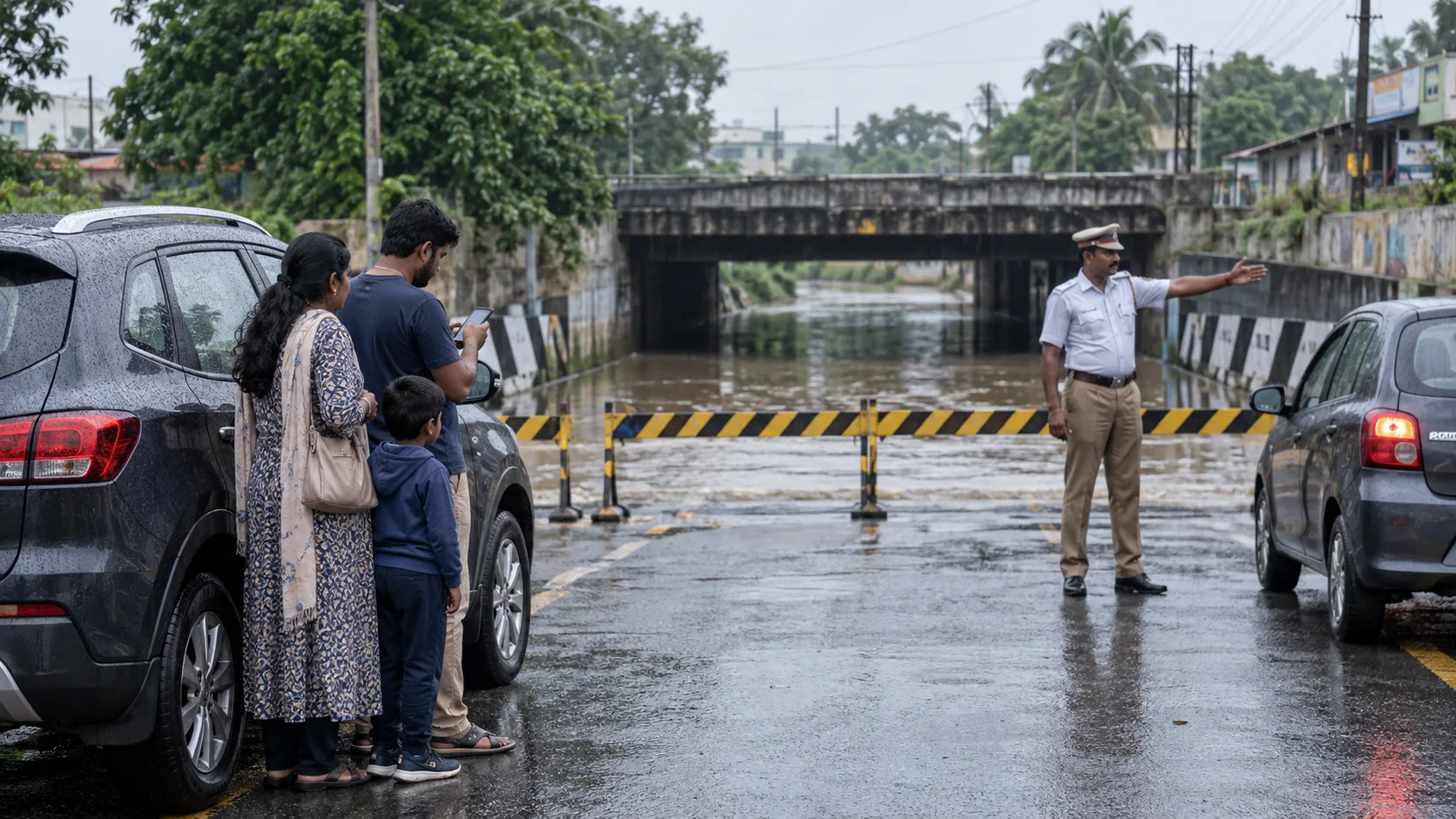
A couple plans a drive toward a hill station. Their weather app shows a cloud-and-rain symbol, but that icon cannot describe slope stability, visibility, fallen branches, local traffic controls or the condition of the approach road. They identify the districts crossed by the route, check the official warning for each and contact their accommodation about the last approach. They avoid scheduling a night arrival and keep enough daylight for a deliberate decision.
Heavy rain before the trip may matter even if departure morning is dry. Saturated slopes, debris and damaged road edges can persist after the cloud has moved. The couple agrees that a closure, police diversion or operator warning ends the attempt. They do not follow an unverified shortcut around a barrier, and they do not substitute a waterfall visit because the flow looks dramatic. A flexible booking and a lower-elevation fallback make that decision financially and emotionally easier.
If the route remains open and conditions are suitable, they drive conservatively, use headlights as required, leave more stopping distance and pause only at safe designated places. If visibility deteriorates, they turn back or stop at a legitimate facility rather than improvising on the shoulder. The hill destination is not the only objective; arriving without transferring risk to local responders is part of responsible travel.
Sources for this section: IMD district warnings, SACHET safety guidance.
Make conservative decisions around floodwater, lightning and the coast
Never enter floodwater on foot or in a vehicle to test its depth. Water can hide an open drain, damaged surface, moving current or electrical risk, and conditions can change faster than they appear from the edge. Turn around at a barricade, diversion or visibly inundated section. Do not use a smaller side road merely because navigation software still draws a line through it. A delayed arrival is a booking problem; entering floodwater can become an emergency.
During thunder and lightning, move into a substantial building or enclosed vehicle and follow current official advice. An open beach, hill viewpoint, field, rooftop or isolated shelter is not a suitable place to wait for the perfect photograph. Keep away from exposed metal structures and do not gather under a lone tree. Resume the activity only when official or local guidance and conditions support it, not when one thunderclap seems distant.
Coastal weather requires its own check. A district rain forecast does not replace fishermen, marine, port or coastal warnings, and a calm-looking shoreline does not prove that waves or currents are safe. Travelers should not approach rough seas for spectacle or pressure fishing and boating operators to continue. If emergency help is genuinely required in India, the Government's Emergency Response Support System uses the nationwide number 112 for police, fire, medical and other urgent assistance.
- Do not walk, drive or ride through floodwater.
- Treat barriers, closures and diversions as final instructions.
- Move indoors during lightning; avoid exposed viewpoints and shorelines.
- Check coastal and fishermen warnings separately from general rain forecasts.
- Use 112 for a genuine emergency, not for weather or travel information.
Sources for this section: SACHET safety guidance, RMC Chennai weather and warnings, India emergency number 112.
Pack and book for change, not for a battle with the weather
Rain-season packing should protect the essentials. Keep identity documents, medicines, charging cables and booking records inside waterproof inner bags rather than trusting the day bag's outer fabric. Carry a compact rain layer, quick-drying clothes and footwear suitable for wet ordinary surfaces. None of this equipment makes a closed trail, flooded street or rough coast safe. Gear supports an approved plan; it does not override a warning.
Save key information offline: accommodation address and phone number, booking references, transport details, a simple route map and the contact of someone outside the traveling group. Charge phones and power banks before a vulnerable road leg. Share only the personal information required for the booking, and avoid public live-location posts. If connectivity fails, a printed booking summary and a written address can be more useful than another travel app.
Protect the budget through structure. Book the weather-sensitive activity separately from the essential transport or stay when practical, and understand which parts are refundable. Leave a buffer before an international flight, examination, medical appointment or other fixed commitment. Travel insurance can have exclusions and evidence requirements, so read the actual policy instead of assuming the word rain guarantees reimbursement.
Sources for this section: SACHET government alerts, India emergency number 112.
What a rain-smart Tamil Nadu trip looks like
A rain-smart trip is not one that avoids every drop. It is one that distinguishes a seasonal onset from a live forecast, a forecast from a warning and a warning from the local access decision. It has a strong base, a small number of essential transfers and alternatives that are genuinely enjoyable. It gives travelers enough time and financial flexibility to obey a closure without feeling that the whole holiday has failed.
It also respects the people working during difficult conditions. Do not demand that a driver enter water, that hotel staff predict a road they do not control or that local responders provide sightseeing updates during an emergency. Buy food and services locally when it is appropriate, but do not turn flooded neighbourhoods into content. Photograph rain-shaped landscapes only from places where visitors are permitted and where stopping does not obstruct residents or emergency movement.
For the 2026 northeast monsoon, keep one simple sequence: consult IMD for the weather signal, SACHET and local authorities for alerts and instructions, the operator for service status and your own booking terms for the cost of changing. Recheck close to travel. Then choose the lower-risk option when information conflicts. Tamil Nadu remains richly visitable in the rainy season, but the best itinerary is always the one willing to become smaller.
Sources for this section: 2026 monsoon transition, RMC Chennai weather and warnings, SACHET government alerts.
Sources & Further Reading
These authoritative references support the historical, geographic, or seasonal context in this story. Current conditions and operating details still require a fresh official check.
- Monsoon Information: Withdrawal of Southwest Monsoon and Commencement of Northeast Monsoon Rainfall Activity, 15 October 2026 · India Meteorological Department
- Regional Meteorological Centre Chennai · India Meteorological Department, Ministry of Earth Sciences
- District-Wise Weather Warnings · India Meteorological Department
- Urban Meteorological Services for Chennai · India Meteorological Department
- SACHET National Disaster Alert Portal · National Disaster Management Authority, Government of India
- Disaster Do's and Don'ts · National Disaster Management Authority, Government of India
- Emergency Response Support System · Government of India
Related Stories
Why Tamil Nadu Has Two Monsoon Seasons: Southwest and Northeast Rain Explained
A geographic explanation of why Tamil Nadu's rain story differs from much of India, and why coast, interior and western hills cannot share one seasonal rule.
Tamil Nadu in the Late Southwest Monsoon: Where to Travel in August and September
A weather-aware way to choose between Tamil Nadu's hills, heritage cities, waterfalls, and coast during August and September.

Tamil Nadu Digital Tourism 2026: AI, Apps and Smarter Trip Planning
Tamil Nadu's new tourism website, app, AI content and innovation challenge point toward a more connected trip. Here is how to use the change carefully.
Frequently asked questions
When did the northeast monsoon begin over Tamil Nadu in 2026?
The India Meteorological Department announced that northeast-monsoon rainfall activity commenced over Tamil Nadu, Puducherry and Karaikal on 15 October 2026, alongside the withdrawal of the southwest monsoon from the country.
Does monsoon onset mean it will rain everywhere in Tamil Nadu?
No. Onset is a seasonal declaration, not a district-by-district forecast for every hour. Check the latest IMD district warning, nowcast and local access information for the exact route and activity.
Should I cancel a Tamil Nadu trip because the northeast monsoon has started?
Not automatically. Review the current warning for the relevant districts, the exposure of your route and activities, operator status and cancellation terms. Change or cancel when official advice or local conditions require it.
Where can I find official Tamil Nadu rain warnings?
Use the India Meteorological Department's Regional Meteorological Centre Chennai pages for bulletins, district warnings, nowcasts and coastal products. The NDMA SACHET portal also carries authorized government alerts.
Is it safe to drive through a flooded road if another vehicle crossed?
No. Do not enter floodwater. Its depth, current, road surface, drains and electrical hazards may be hidden. Follow barriers and diversions and choose another route or wait in a safe place.
What should I save offline before traveling in heavy-rain season?
Save booking references, accommodation address and phone, transport details, a simple route map, emergency contacts and official alert links. Protect documents and medicines in waterproof inner bags.
Can I visit beaches or waterfalls during the northeast monsoon?
Only when current official warnings, local access rules and on-site conditions support the visit. Avoid rough seas, exposed shores, high-flow water, closed paths and any attempt to enter water for a photograph.
What emergency number should travelers use in India?
For a genuine emergency requiring police, fire, medical or other urgent assistance, India's nationwide Emergency Response Support System uses 112. Do not call it for routine forecasts or travel information.
Editorial attribution
Prepared and reviewed by My Tamil Nadu Editorial Desk. Modified 15 October 2026.